

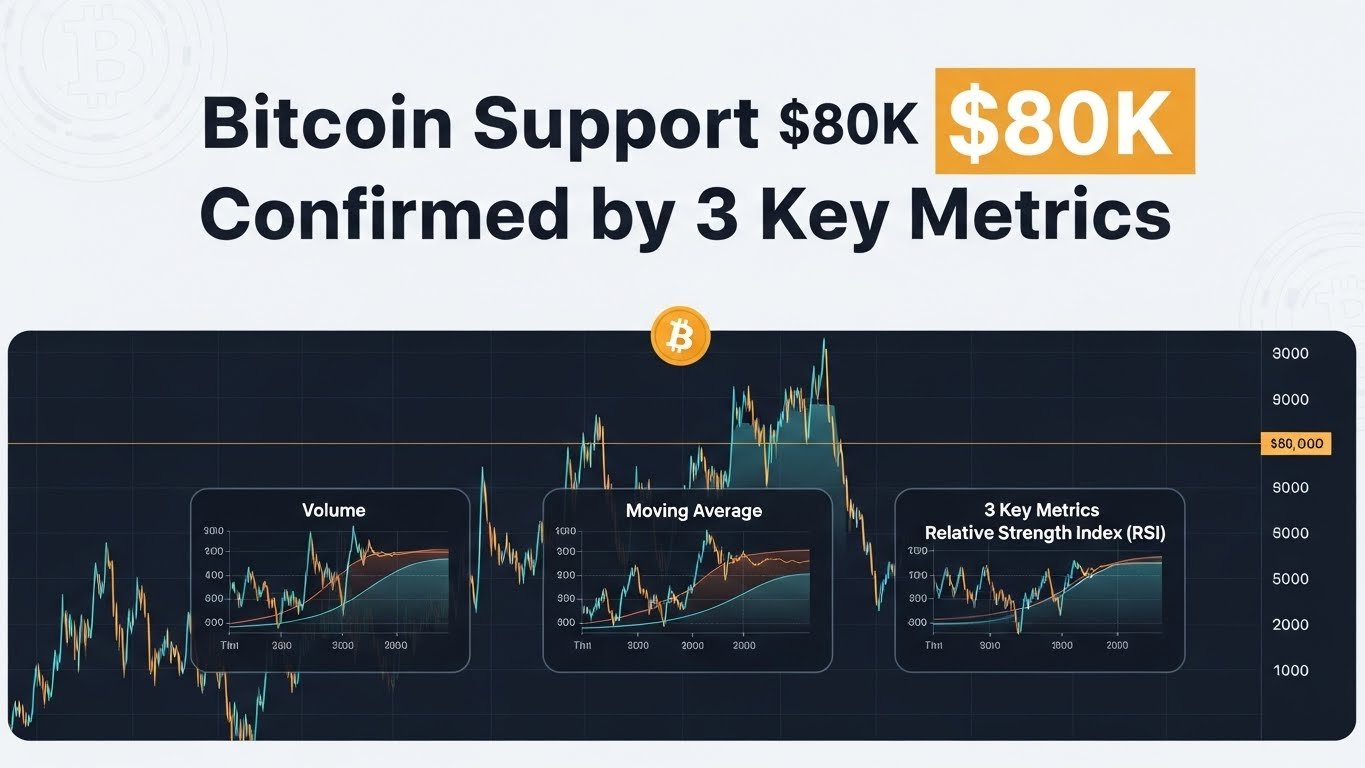
Bitcoin has once again proven why it remains the most closely watched asset in the digital finance world. As price volatility continues to dominate headlines, one level has recently captured the attention of traders, analysts, and long-term investors alike: Bitcoin support near $80,000. After weeks of sharp price movements, fear-driven sell-offs, and intense market speculation, Bitcoin appears to have stabilized around this psychologically significant zone.
Support levels in cryptocurrency markets are never just random price points. They are shaped by investor behavior, market structure, and underlying on-chain activity. In Bitcoin’s case, the $80,000 region has emerged as a crucial battleground between buyers and sellers. What makes this level especially important is that multiple independent metrics all point toward the same conclusion: Bitcoin has found strong support near $80,000.
This article explores how three essential indicators—on-chain data, derivatives market signals, and long-term holder behavior—combine to confirm that Bitcoin’s recent price action is not merely a temporary pause but a structurally meaningful support zone. By understanding these metrics in depth, investors can gain clearer insight into Bitcoin price trends, market sentiment, and the potential path forward for the world’s leading cryptocurrency.
Why the $80,000 Level Matters for Bitcoin

Bitcoin price levels are often influenced as much by psychology as by technical factors. Round numbers tend to attract attention, and $80,000 represents a major milestone in Bitcoin’s historical price evolution. After breaking previous all-time highs, Bitcoin entered a phase of consolidation where the market needed to determine fair value.
The importance of Bitcoin price support near $80,000 lies in how frequently the market has tested and defended this zone. Each time Bitcoin dipped toward this level, buyers stepped in with enough conviction to absorb selling pressure. This repeated defense suggests that market participants view prices near $80,000 as attractive entry points rather than warning signs of further decline.
Beyond psychology, macroeconomic conditions and institutional participation also play a role. As Bitcoin increasingly behaves like a global macro asset, its support levels are influenced by liquidity cycles, interest rate expectations, and broader risk sentiment. The $80,000 region has emerged during a period when institutional demand, exchange-traded products, and on-chain accumulation all intersect, reinforcing its significance.
Metric One: On-Chain Data Confirms Strong Accumulation
Understanding On-Chain Metrics in Bitcoin Analysis
On-chain data provides a transparent view into Bitcoin’s network activity. Unlike traditional markets, Bitcoin allows analysts to observe wallet balances, transaction flows, and holding patterns in real time. These metrics offer powerful insight into whether investors are accumulating or distributing coins at certain price levels.
When Bitcoin approaches a key support zone, on-chain indicators often reveal whether that level is being defended by genuine demand. In the case of Bitcoin found strong support near $80,000, on-chain data shows a clear pattern of accumulation rather than panic selling.
Exchange Outflows Signal Investor Confidence
One of the most telling on-chain indicators is exchange outflows. When Bitcoin leaves centralized exchanges, it usually indicates that investors are moving assets into long-term storage rather than preparing to sell. During Bitcoin’s recent consolidation around $80,000, exchanges recorded sustained net outflows.
This behavior suggests that market participants are confident in Bitcoin’s long-term value and see current prices as opportunities rather than risks. Historically, periods of strong exchange outflows have preceded bullish price trends, reinforcing the idea that Bitcoin support at $80,000 is structurally sound.
Wallet Growth Near the Support Zone
Another compelling on-chain signal comes from wallet growth. Addresses holding significant amounts of Bitcoin increased notably during price dips toward $80,000. This pattern indicates that both retail and institutional investors were actively accumulating Bitcoin at this level.
The growth of long-term holding wallets is particularly important. These investors tend to be less sensitive to short-term volatility, meaning their buying activity helps stabilize prices. As a result, on-chain accumulation provides strong evidence that Bitcoin found durable support near $80,000.
Metric Two: Derivatives Market Shows Reduced Downside Risk
The Role of Futures and Options in Bitcoin Price Discovery
The Bitcoin derivatives market plays a crucial role in shaping short-term price movements. Futures and options reflect trader sentiment, leverage usage, and expectations for future volatility. When analyzing whether a support level is reliable, derivatives data can reveal whether traders are positioning for further downside or preparing for a rebound.
At the $80,000 level, derivatives metrics strongly favor the interpretation that Bitcoin downside risk has diminished.
Funding Rates Indicate Balanced Market Sentiment
Funding rates in perpetual futures contracts are a key indicator of market bias. Extremely high funding rates suggest overcrowded long positions, while deeply negative rates imply excessive bearishness. During Bitcoin’s consolidation near $80,000, funding rates normalized after prior volatility.
This balance indicates a healthier market structure. Traders were no longer aggressively betting on price declines, nor were they excessively leveraged on the long side. Such equilibrium often appears when a strong support level has been established.
Open Interest Stability Strengthens the Support Thesis
Open interest measures the total value of outstanding derivative contracts. When Bitcoin price falls sharply and open interest collapses, it signals forced liquidations and weak support. However, near the $80,000 region, open interest remained stable even during pullbacks.
This stability shows that traders maintained their positions rather than exiting in fear. It also suggests that leverage was being managed more responsibly, reducing the likelihood of cascading liquidations. Together, these derivatives signals reinforce the conclusion that Bitcoin found strong support near $80,000.
Metric Three: Long-Term Holder Behavior Signals Conviction
Who Are Bitcoin’s Long-Term Holders?
Long-term holders are investors who typically hold Bitcoin for months or years without selling. Their behavior provides valuable insight into market conviction. Historically, when long-term holders begin distributing coins, it often signals market tops. Conversely, when they accumulate or hold through volatility, it suggests confidence in future price appreciation.
At the $80,000 level, long-term holder behavior has been notably bullish.
Reduced Selling Pressure from Long-Term Investors
Data shows that long-term holders significantly reduced selling activity as Bitcoin approached $80,000. Instead of distributing coins into the market, these investors chose to hold or even increase their positions.
This reduction in selling pressure plays a critical role in maintaining support. When fewer coins are available for sale, it becomes easier for buyers to defend key price levels. The actions of long-term holders therefore act as a stabilizing force for Bitcoin price support.
Supply in Profit Remains Healthy

Another related metric is the percentage of Bitcoin supply in profit. Even during recent corrections, a large portion of the supply remained above its acquisition price. This indicates that most holders were not under financial stress, reducing the likelihood of panic-driven selling.
A healthy supply in profit supports the idea that Bitcoin’s market structure remains strong. Combined with long-term holder conviction, it further confirms that Bitcoin support near $80,000 is not fragile but deeply rooted in investor behavior.
How These Three Metrics Work Together
While each metric individually suggests strength, their combined impact is what makes the $80,000 support level particularly compelling. On-chain accumulation shows real demand, derivatives data indicates reduced downside risk, and long-term holder behavior reflects confidence in Bitcoin’s future.
When multiple independent data sources align, the probability of a reliable support zone increases significantly. This convergence is rare during periods of uncertainty, making Bitcoin’s current market structure especially noteworthy.
The alignment of these indicators also reduces the influence of short-term noise. Temporary price fluctuations, news-driven volatility, or isolated sell-offs become less meaningful when underlying metrics continue to signal strength. As a result, traders and investors can interpret Bitcoin’s consolidation near $80,000 as a foundation rather than a weakness.
Broader Market Implications of Bitcoin’s $80,000 Support
Bitcoin often sets the tone for the broader cryptocurrency market. When Bitcoin establishes strong support, it tends to reduce overall market volatility and restore investor confidence across altcoins.
The confirmation that Bitcoin found strong support near $80,000 has implications beyond Bitcoin itself. It suggests that capital remains committed to the crypto ecosystem and that institutional participation continues to grow. This environment can encourage innovation, adoption, and long-term investment across the digital asset space.
Moreover, strong Bitcoin support helps redefine market cycles. Instead of deep bear markets following every correction, Bitcoin may be transitioning into a more mature phase characterized by higher structural support levels and reduced extreme volatility.
What This Means for Bitcoin’s Future Price Action
Support levels do not guarantee immediate upward movement, but they provide a foundation for future trends. With $80,000 acting as a confirmed support zone, Bitcoin has greater flexibility to consolidate, build momentum, and eventually test higher resistance levels.
If macroeconomic conditions remain favorable and institutional demand continues, Bitcoin could use this support as a springboard for further price discovery. Even in the event of short-term pullbacks, the strength of current metrics suggests that downside risk may be limited.
For long-term investors, the confirmation of strong support offers reassurance. For traders, it provides a clearer framework for risk management. In both cases, understanding why Bitcoin found support near $80,000 enhances decision-making in an increasingly complex market.
Conclusion
Bitcoin’s ability to hold above key levels is never accidental. The emergence of strong support near $80,000 is the result of real demand, disciplined trading behavior, and long-term conviction from investors who believe in Bitcoin’s future.
Through on-chain accumulation, balanced derivatives markets, and unwavering long-term holder confidence, three powerful metrics converge on the same conclusion: Bitcoin found strong support near $80,000. This alignment strengthens Bitcoin’s market structure and sets the stage for future growth, even amid ongoing volatility.
As Bitcoin continues to evolve as a global financial asset, understanding these foundational signals becomes essential. The $80,000 level is more than just a number—it represents trust, resilience, and the growing maturity of the Bitcoin market.
FAQs
Q; Why is Bitcoin support near $80,000 considered strong?
Bitcoin support near $80,000 is considered strong because multiple indicators, including on-chain accumulation, derivatives stability, and long-term holder behavior, all show sustained buying interest and reduced selling pressure at this level.
Q; How does on-chain data confirm Bitcoin found support?
On-chain data confirms support by showing increased wallet accumulation and exchange outflows, indicating that investors are holding Bitcoin rather than selling it during price dips near $80,000.
Q; What role do derivatives markets play in identifying support levels?
Derivatives markets reflect trader sentiment and leverage. Balanced funding rates and stable open interest near $80,000 suggest reduced downside risk and reinforce the strength of Bitcoin’s support.
Q; Are long-term holders important for Bitcoin price stability?
Yes, long-term holders play a crucial role because their willingness to hold through volatility reduces selling pressure and helps establish durable support levels in the market.
Q; Does strong support guarantee Bitcoin will rise in price?
Strong support does not guarantee immediate price increases, but it reduces downside risk and provides a foundation for future upward trends when market conditions become favorable.
See more;Bitcoin Price Fed Interest Rate Cut Impact | Crypto Analysis 2025
