

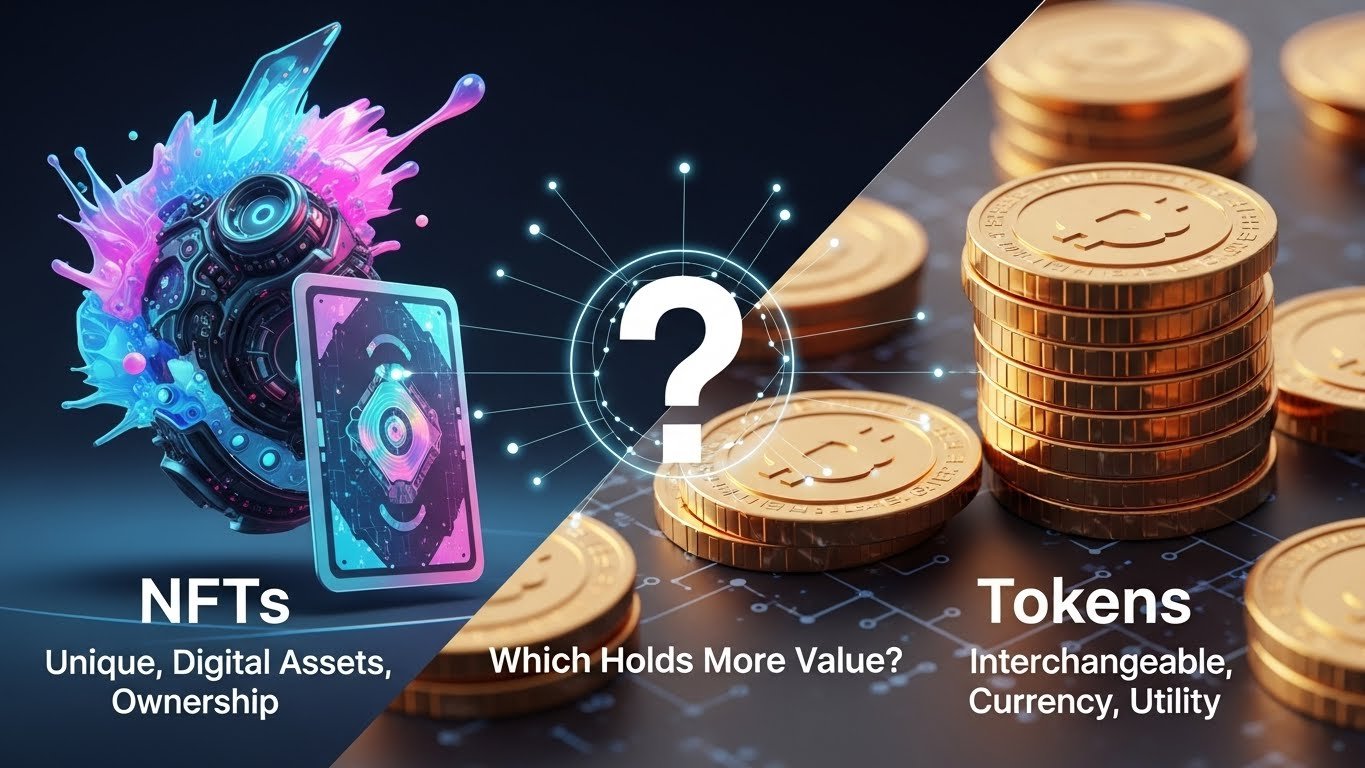
NFTs vs tokens in Web3 has intensified as blockchain technology continues to revolutionize digital ownership and value exchange. While both represent revolutionary innovations in the decentralized internet, their purposes, applications, and long-term significance differ dramatically. Understanding whether NFTs matter more than tokens in Web3 requires examining their fundamental characteristics, real-world utility, and transformative potential across industries. Non-fungible tokens have captured mainstream attention through digital art sales and celebrity endorsements, while cryptocurrency tokens power decentralized finance and governance systems. This comprehensive analysis explores both assets’ roles in shaping the future of Web3 technology, helping you determine which holds greater significance for the evolving digital economy.
Fundamental Differences Between NFTs and Tokens
The Web3 ecosystem operates on blockchain technology, but not all digital assets function identically. Recognizing the core distinctions between NFTs and tokens forms the foundation for evaluating their respective importance.
What Makes NFTs Unique in the Digital Landscape
Non-fungible tokens represent unique digital assets that cannot be exchanged on a one-to-one basis like traditional currencies. Each NFT contains distinct metadata and identification codes stored on blockchain networks, making them irreplaceable and individually verifiable. This uniqueness enables digital ownership of items ranging from artwork and music to virtual real estate and gaming items. The non-fungible nature means one NFT cannot substitute for another, even within the same collection, because each possesses individual characteristics and provenance records.
The technology behind NFTs leverages smart contracts to encode ownership rights and transferability rules directly into the blockchain. When someone purchases an NFT, they acquire verifiable proof of ownership recorded permanently across distributed ledgers. This verification system eliminates forgery concerns while establishing transparent ownership histories that trace back to original creators. Artists, musicians, and content creators particularly benefit from NFT technology because smart contracts can automatically distribute royalties whenever their work resells in secondary markets.
How Cryptocurrency Tokens Function in Web3
Cryptocurrency tokens operate as fungible digital assets where each unit holds identical value and utility. These tokens serve multiple purposes within the Web3 framework, including facilitating transactions, enabling governance participation, and representing stakes in decentralized protocols. Unlike NFTs, tokens are interchangeable, meaning one Bitcoin equals another Bitcoin in value and functionality, similar to how traditional currency works.
The fungible nature of tokens makes them ideal for creating economic systems within decentralized applications. Utility tokens grant holders access to specific services or products within blockchain platforms, while governance tokens enable community members to vote on protocol changes and development directions. Security tokens represent ownership in underlying assets like real estate or company equity, bridging traditional finance with blockchain innovation. This versatility positions cryptocurrency tokens as fundamental infrastructure powering the entire Web3 economy.
The Value Proposition of NFTs in Modern Web3 Applications
Examining the practical applications and value creation mechanisms of NFTs in Web3 reveals their significance beyond speculative trading and celebrity endorsements.
Digital Art and Creative Economy Transformation
The creative industries have experienced revolutionary changes through NFT adoption, fundamentally altering how artists monetize their work and engage with audiences. Traditional art markets involved intermediaries like galleries and auction houses that extracted significant portions of sale proceeds while controlling access to collectors. NFT technology democratizes this process by enabling direct creator-to-collector transactions, with artists retaining larger revenue shares and maintaining ongoing relationships with their supporter base.
Beyond initial sales, programmable royalties embedded in smart contracts ensure creators receive compensation from secondary market transactions perpetually. This innovation addresses longstanding challenges where artists profited only from original sales while collectors reaped all appreciation benefits. Musicians similarly leverage NFTs to release limited edition recordings, concert tickets, and exclusive experiences directly to fans, bypassing traditional record label structures that historically captured most revenue.
The provenance tracking inherent to blockchain technology also combats forgery and authentication issues plaguing traditional art markets. Collectors gain confidence knowing each digital asset’s ownership history is transparently recorded and independently verifiable. This transparency extends to physical artworks too, with NFTs serving as certificates of authenticity linking tangible pieces to blockchain records.
Gaming and Virtual World Integration
The gaming industry represents one of the most promising frontiers for NFT implementation in Web3. Traditional gaming models trapped players in closed ecosystems where purchased items, earned rewards, and developed characters held no value beyond individual game environments. When players stopped engaging with specific games, their accumulated investments disappeared entirely.
Non-fungible tokens revolutionize this paradigm by enabling true ownership of in-game assets that persist across platforms and maintain transferable value. Players can purchase, earn, or create unique items as NFTs, then trade them in open marketplaces, use them across compatible games, or sell them when moving to different gaming experiences. This interoperability transforms gaming from pure entertainment into potential income sources, particularly in play-to-earn models where skilled players monetize their gameplay.
Virtual worlds and metaverse platforms extensively utilize NFTs for representing land parcels, buildings, avatars, wearables, and countless other digital possessions. These virtual real estate holdings can appreciate based on location desirability, development quality, and community growth, creating entirely new asset classes within digital economies. Major brands and businesses purchase metaverse land as NFTs to establish virtual presences, host events, and engage with increasingly digital-native consumer bases.
Identity and Credential Verification Systems
Beyond commercial applications, NFTs provide powerful solutions for digital identity management and credential verification. Traditional systems for storing educational certificates, professional licenses, and identification documents remain vulnerable to loss, damage, and fraudulent replication. Blockchain-based NFT credentials solve these problems by creating tamper-proof, easily verifiable records that individuals control directly.
Universities increasingly issue diplomas as NFTs, allowing graduates to prove their qualifications instantly to potential employers without requesting official transcripts or waiting for verification processes. Professional organizations similarly adopt NFT-based licenses and certifications, creating transparent credential systems that reduce verification burdens while preventing fraud. Healthcare providers explore NFT implementations for managing medical records, enabling patients to control access while ensuring information accuracy and privacy.
The Web3 identity paradigm extends beyond credentials to encompass reputation systems, community memberships, and achievement records. Users can accumulate NFTs representing their participation in various communities, contributions to projects, or accomplishments in different domains, building comprehensive digital identities they own and control rather than fragmenting their presence across corporate platforms.
The Critical Role of Tokens in Web3 Infrastructure
While NFTs capture headlines, cryptocurrency tokens form the essential foundation enabling the entire Web3 ecosystem to function and scale.
Decentralized Finance Revolution Through Tokenization
Decentralized finance platforms fundamentally reimagine financial services by eliminating traditional intermediaries through token-based systems. Users can lend, borrow, trade, and earn yields on crypto assets without banks, brokers, or other centralized institutions controlling access or extracting fees. Governance tokens enable community-driven decision-making about protocol parameters, fee structures, and development priorities, democratizing financial system management.
Liquidity provider tokens reward users who supply capital to decentralized exchanges, enabling peer-to-peer trading without order book systems or market makers. Staking mechanisms allow token holders to secure blockchain networks while earning passive income, replacing traditional savings accounts with potentially higher yields. These innovations create more accessible financial systems that operate continuously without geographic restrictions or discrimination based on credit histories.
The composability of token-based DeFi protocols enables developers to build sophisticated financial products by combining existing services like digital Lego blocks. Users might deposit tokens as collateral to borrow other assets, swap those borrowed funds across decentralized exchanges, provide liquidity to earn fees, and stake rewards in governance systems, all within seamlessly integrated workflows. This programmable money concept represents fundamental innovation beyond anything traditional finance offers.
Governance and Community Coordination
Governance tokens solve critical coordination challenges facing decentralized organizations by enabling transparent, inclusive decision-making processes. Traditional corporate structures concentrate power among executives and boards, often misaligning stakeholder interests with actual community needs. Token-based governance distributes voting power among users, developers, and investors, ensuring protocol evolution reflects diverse perspectives.
Decentralized autonomous organizations utilize tokens to coordinate global communities working toward shared objectives without hierarchical management structures. Token holders propose initiatives, debate approaches, and vote on implementations, with smart contracts automatically executing approved decisions. This model enables unprecedented collaboration scales while maintaining transparency and accountability through publicly auditable blockchain records.
The economic alignment created by governance token ownership incentivizes participants to make decisions benefiting long-term protocol health rather than pursuing short-term extraction. When community members hold meaningful stakes in platform success, they naturally prioritize sustainable growth, user experience improvements, and ecosystem development over maximizing immediate profits. This alignment mechanism proves particularly powerful for open-source projects that traditionally struggled with funding and contributor coordination.
Utility and Access Token Models
Beyond governance functions, utility tokens serve as access keys unlocking services, features, or resources within blockchain platforms. Decentralized storage networks require users to hold and spend tokens when saving files, incentivizing node operators who provide storage capacity with token rewards. Computing networks similarly utilize tokens to compensate providers of processing power while enabling customers to purchase computational resources.
This token-based access model creates self-sustaining ecosystems where supply and demand naturally balance through market mechanisms. As platform usage increases, token demand rises, potentially appreciating token value and attracting more service providers seeking revenue opportunities. The increased supply then supports additional users, creating positive feedback loops that enable network growth without centralized coordination or capital requirements.
Content platforms implement utility tokens to reward creators based on engagement metrics, distribute platform revenues to contributors, and enable fans to support favorite creators directly. These systems align incentives across all participants while reducing dependence on advertising models that compromise user privacy and experience quality. Subscription services, educational platforms, and professional networks increasingly explore token integration for similar benefits.
Comparing Market Performance and Adoption Trends
Evaluating whether NFTs matter more than tokens in Web3 requires examining market dynamics, adoption patterns, and real-world impact metrics.
Market Capitalization and Trading Volume Analysis
The cryptocurrency token market substantially exceeds NFT markets in total value and daily trading volumes, reflecting their fundamental role in blockchain ecosystems. Major tokens like Bitcoin and Ethereum command market capitalizations exceeding hundreds of billions of dollars, with daily trading volumes reaching tens of billions across global exchanges. This liquidity enables institutional adoption, regulatory clarity efforts, and integration with traditional financial systems.
NFT markets experienced explosive growth during peak periods, with monthly trading volumes briefly exceeding billions of dollars across major platforms. However, these markets demonstrate higher volatility and concentration, with relatively few collections accounting for disproportionate transaction volumes. The speculative nature of many NFT investments creates boom-and-bust cycles more pronounced than token markets, though blue-chip collections maintain relatively stable floor prices similar to established tokens.
Infrastructure tokens supporting DeFi platforms, layer-two scaling solutions, and fundamental blockchain networks show stronger correlation with genuine utility and adoption than many NFT projects. As protocols mature and user bases expand, token values often reflect growing network effects and revenue generation. NFT valuations depend more heavily on cultural factors, community strength, and individual asset uniqueness, making systematic analysis more challenging than evaluating fungible token projects.
Institutional and Enterprise Adoption Patterns
Major corporations increasingly explore both NFTs and tokens for different strategic purposes. Financial institutions focus primarily on blockchain infrastructure tokens, developing trading platforms, custody solutions, and investment products for clients seeking crypto exposure. Payment processors integrate cryptocurrency acceptance, while traditional exchanges launch digital asset trading services, legitimizing tokens as investment vehicles.
NFT adoption by enterprises concentrates in specific verticals where unique digital assets provide clear value propositions. Luxury brands create NFT collections extending physical products into digital realms, offering exclusive experiences and fostering community engagement. Sports leagues issue NFT collectibles and tickets, experimenting with fan engagement models and additional revenue streams. Entertainment companies explore NFT integration for intellectual property monetization and audience participation mechanisms.
The divergent adoption patterns suggest tokens serve as foundational infrastructure while NFTs provide specialized applications within that infrastructure. Enterprises require robust, liquid token markets for treasury management, payment processing, and financial operations before implementing NFT-specific initiatives. This layered adoption model positions tokens as prerequisites for broader Web3 integration rather than competing alternatives to NFTs.
Technical Infrastructure and Scalability Considerations
The technical foundations supporting NFTs versus tokens in Web3 significantly impact their long-term viability and mainstream adoption potential.
Blockchain Network Requirements and Constraints
Cryptocurrency tokens generally require less computational resources and storage capacity than NFTs because they involve simpler data structures and transaction types. Transferring fungible tokens only updates balance records across addresses, while NFT transfers involve unique metadata, ownership histories, and potentially linked media files. This efficiency difference becomes crucial as networks scale and transaction volumes increase.
Major blockchain networks implement different approaches balancing security, decentralization, and scalability when supporting both asset types. Layer-one blockchains prioritize security and decentralization but face throughput limitations constraining transaction speeds and costs. Layer-two solutions improve scalability by processing transactions off main chains while periodically settling to base layers, enabling higher volumes at lower costs for both tokens and NFTs.
The technical requirements for NFT storage present particular challenges because associated media files often exceed practical blockchain storage limits. Projects typically store actual images, videos, or audio files on decentralized storage networks or traditional servers, with blockchain records containing only metadata and file location pointers. This hybrid approach introduces centralization risks and permanence concerns that purely on-chain token transactions avoid.
Environmental Impact and Sustainability Factors
Energy consumption associated with blockchain operations significantly influences public perception and regulatory approaches toward crypto assets. Proof-of-work consensus mechanisms securing networks like Bitcoin require substantial electricity for mining operations, raising environmental sustainability questions. Token transactions on these networks share proportional responsibility for overall network energy usage.
NFT minting on proof-of-work chains faced particular criticism because creating unique tokens for digital art seemed frivolous compared to financial transaction facilitation. However, major platforms transitioning to proof-of-stake consensus mechanisms reduced energy consumption by over ninety-nine percent, largely addressing these concerns. Ethereum’s shift to proof-of-stake dramatically improved both token and NFT environmental profiles while maintaining security guarantees.
The sustainability debate influences which blockchain networks attract developers and users for different applications. Environmentally conscious artists increasingly prefer energy-efficient chains for NFT projects, while DeFi platforms balance environmental considerations against security, liquidity, and user base factors. As regulatory frameworks increasingly incorporate carbon footprint considerations, networks demonstrating sustainability commitment may gain competitive advantages regardless of specific asset types supported.
Regulatory Landscape and Legal Considerations
Government approaches to regulating NFTs and tokens in Web3 differ substantially, impacting their development trajectories and mainstream acceptance.
Securities Law and Token Classification
Regulatory bodies worldwide scrutinize cryptocurrency tokens intensely, particularly regarding securities law compliance. The fundamental question centers on whether specific tokens constitute investment contracts subject to securities regulations. Factors including funding methods, profit expectations, and reliance on management efforts determine classification outcomes with significant compliance implications.
Utility tokens designed primarily for accessing services rather than investment purposes may avoid securities classification, though this distinction proves difficult maintaining practically. Governance tokens granting voting rights without direct profit claims occupy ambiguous regulatory spaces. Securities tokens explicitly designed as regulated financial instruments face stricter oversight but gain legitimacy and accessibility for institutional investors seeking compliance clarity.
NFT regulation remains less developed because unique digital assets fit awkwardly into existing securities frameworks designed for fungible instruments. Most NFTs representing art, collectibles, or game items likely avoid securities classification because buyers acquire specific items rather than investment interests in common enterprises. However, fractionalized NFT ownership models potentially trigger securities laws by creating fungible shares in underlying unique assets.
Intellectual Property and Ownership Rights
The digital ownership model enabled by NFTs creates complex intellectual property questions that legal systems continue addressing. Purchasing an NFT typically conveys ownership of the token itself but not automatically the underlying intellectual property rights to associated creative works. Artists often retain copyrights, reproduction rights, and commercial use permissions unless explicitly transferred through accompanying legal agreements.
This distinction confuses many NFT buyers who assume acquisition includes comprehensive ownership rights similar to purchasing physical art. Smart contract capabilities enable creators to program specific usage rights, restrictions, and royalty structures directly into tokens, but legal enforcement beyond blockchain ecosystems remains uncertain. Courts worldwide are beginning establishing precedents for NFT-related disputes, gradually clarifying rights and responsibilities.
Token intellectual property concerns differ because fungible assets rarely involve unique creative works requiring copyright protection. Instead, token projects face trademark issues regarding names, logos, and branding elements. Open-source protocols must balance protecting distinctive marks against encouraging ecosystem development and composability. The decentralized nature of Web3 projects complicates traditional intellectual property enforcement while enabling innovation through permissionless building.
Use Case Analysis: Where Each Asset Type Excels
Determining whether NFTs matter more than tokens requires examining specific applications where each technology provides optimal solutions.
When NFTs Provide Superior Solutions
Non-fungible tokens excel in scenarios requiring provable uniqueness, ownership verification, and individual asset tracking. Digital collectibles benefit from NFT technology because scarcity and authenticity drive value, with blockchain verification eliminating forgery concerns. Event ticketing improves through NFT implementation by preventing counterfeiting, enabling secure transfers, and potentially providing ongoing holder benefits through programmable utility.
Real estate tokenization utilizes NFTs for representing individual properties, capturing unique characteristics like location, features, and history that distinguish assets from one another. Supply chain tracking leverages NFTs to monitor individual products throughout manufacturing, distribution, and retail processes, creating transparent provenance records valuable for luxury goods, pharmaceuticals, and other authentication-critical industries.
The creative economy particularly benefits from NFT capabilities because artists produce unique works requiring individual recognition and compensation structures. Musicians release limited edition recordings, concert experiences, and exclusive content as NFTs, building direct relationships with supporters while capturing value from secondary market activity. Writers experiment with NFT-based publishing models granting token holders access to evolving stories, community participation, and potential revenue sharing.
When Tokens Deliver Better Results
Cryptocurrency tokens provide optimal solutions for applications requiring fungibility, divisibility, and seamless exchange. Payment systems need tokens enabling quick, low-cost transactions with standardized values across parties. Decentralized finance protocols require fungible collateral, lending assets, and governance mechanisms that tokens naturally provide without NFT complexity.
Platform ecosystems benefit from utility token models that incentivize network participation, reward contributions, and enable resource allocation through market mechanisms. The fungible nature allows easy trading, price discovery, and liquidity provision that unique assets cannot efficiently support. Incentive alignment across decentralized communities works best with tokens enabling proportional ownership stakes and voting power distribution.
Microtransactions and content monetization favor tokens over NFTs because frequent, small-value exchanges require minimal transaction costs and instant settlement. Streaming content payments, social media tipping, and pay-per-use services operate more efficiently with divisible tokens than unique digital assets. The interoperability of major tokens across platforms and applications provides liquidity and utility advantages difficult for specialized NFT projects to match.
Integration and Convergence Trends in Web3
The future likely involves increasing integration between NFTs and tokens rather than one completely displacing the other in importance.
Hybrid Models Combining Both Asset Types
Innovative projects increasingly combine fungible and non-fungible token characteristics, creating hybrid models capturing benefits from both approaches. Fractionalized NFTs enable multiple users to own shares in high-value unique assets, transforming exclusive items into accessible investment opportunities. This model maintains NFT uniqueness at the base layer while creating fungible derivative tokens facilitating trading and price discovery.
Gaming platforms integrate both asset types extensively, using tokens for in-game currencies, governance, and platform economics while deploying NFTs for unique characters, items, and land parcels. This combination provides economic efficiency through fungible tokens alongside meaningful uniqueness and personalization through non-fungible assets. Players seamlessly interact with both types within unified experiences rather than treating them as separate categories.
Metaverse platforms similarly blend tokens and NFTs throughout their ecosystems. Virtual world currencies operate as fungible tokens enabling transactions, while unique land parcels, buildings, and avatar accessories exist as NFTs. The economic systems require both elements functioning cohesively, with tokens providing liquidity and NFTs delivering differentiation and individual ownership experiences.
The Evolution of Asset Standards and Interoperability
Technical standards governing token and NFT implementation continue evolving, improving functionality, interoperability, and user experience. Enhanced metadata standards enable richer NFT representations supporting dynamic content, unlockable features, and complex ownership rights. Token standards increasingly incorporate features like automatic taxation, compliance hooks, and governance capabilities directly into smart contracts.
Cross-chain compatibility efforts aim enabling seamless asset transfers across different blockchain networks, reducing fragmentation and improving capital efficiency. Bridges, wrapped tokens, and interoperability protocols allow users to move digital assets between ecosystems based on optimal costs, features, or community preferences. This convergence strengthens the overall Web3 ecosystem regardless of specific asset type preferences.
The boundaries between tokens and NFTs may blur further as technology enables creating assets with custom fungibility characteristics. Semi-fungible tokens combine properties of both categories, supporting use cases like event tickets that behave as unique assets until redeemed, then become fungible. These innovations suggest future classification systems may expand beyond the binary NFT versus token framework.
Investment Perspectives and Risk Considerations
Understanding the investment characteristics of NFTs compared to tokens in Web3 helps evaluate their relative significance and future potential.
Volatility and Risk Profiles
Cryptocurrency tokens generally demonstrate high volatility compared to traditional assets but show more established price discovery mechanisms than most NFTs. Major tokens trade on numerous exchanges with substantial liquidity, enabling relatively efficient markets despite volatility. Price movements correlate with adoption metrics, technological developments, regulatory announcements, and broader cryptocurrency market sentiment.
NFT investments face additional volatility sources including subjective valuations, thin liquidity, and concentration risk within individual collections. Floor prices for popular collections can drop dramatically during market downturns as speculative interest evaporates. The uniqueness that makes NFTs valuable also complicates selling during adverse conditions because finding buyers for specific items proves more challenging than selling fungible tokens.
Diversification strategies differ substantially between asset types. Token portfolios spread risk across multiple projects, sectors, and use cases relatively easily through fungible nature enabling fractional positions. NFT diversification requires significantly more capital because acquiring meaningful exposure across multiple collections demands purchasing complete tokens rather than fractional shares. This barrier limits effective diversification to well-capitalized investors.
Long-Term Value Drivers and Sustainability
Evaluating long-term prospects requires identifying fundamental value drivers beyond speculative trading activity. Token valuations increasingly reflect protocol revenues, user growth, total value locked, and network effects as markets mature. Projects generating sustainable cash flows through transaction fees, service charges, or other mechanisms demonstrate clearer value propositions than purely speculative assets.
NFT long-term value depends heavily on cultural significance, community strength, brand recognition, and utility provision. Collections maintaining active communities, developing ongoing utility, and achieving cultural icon status demonstrate greater staying power than purely speculative projects. The transition from profile picture collections toward NFTs providing real-world utility, exclusive access, or intellectual property rights suggests maturing market dynamics.
The sustainability of both markets depends on continued Web3 adoption and technological development addressing current limitations. Scalability improvements enabling lower transaction costs expand potential use cases. Regulatory clarity reduces uncertainty, inhibiting institutional participation. User experience enhancements make blockchain technology accessible beyond technical enthusiasts. These developments benefit both tokens and NFTs rather than favoring one over the other exclusively.
Conclusion
The question of whether NFTs matter more than tokens in Web3 ultimately presents a false dichotomy. Both asset types serve essential but distinct functions within the emerging decentralized internet, with their relative importance varying across specific applications and use cases. Cryptocurrency tokens form the fundamental infrastructure powering blockchain economies, enabling transactions, governance, and financial innovation that make entire ecosystems viable. Their liquidity, fungibility, and established markets position them as cornerstones of Web3 development.
Non-fungible tokens provide critical capabilities that fungible assets cannot deliver, particularly regarding unique digital ownership, creative economy empowerment, and individual asset tracking. Their cultural impact and mainstream awareness exceed tokens in many contexts despite smaller market capitalizations. The convergence of both technologies through hybrid models, improved standards, and cross-chain compatibility suggests the future involves sophisticated integration rather than competition.
The Web3 ecosystem ultimately benefits from the complementary strengths each asset type contributes. Tokens provide economic foundations while NFTs enable differentiation and personalization. Successful platforms leverage both appropriately, based on specific requirements rather than ideologically committing to single approaches. As blockchain technology matures and adoption expands, the distinction between NFTs and tokens may become less relevant than how effectively projects combine both tools toward meaningful applications.
Ready to explore the evolving world of NFTs and tokens in Web3? Start by identifying which technology best serves your specific needs, whether creating unique digital experiences through NFTs or building economic systems with tokens. The decentralized future offers opportunities for both, and understanding their complementary roles positions you to navigate this transformation effectively.
See more: Best Crypto Wallets (Oct 2025) Bitcoin NFTs & DeFi
