

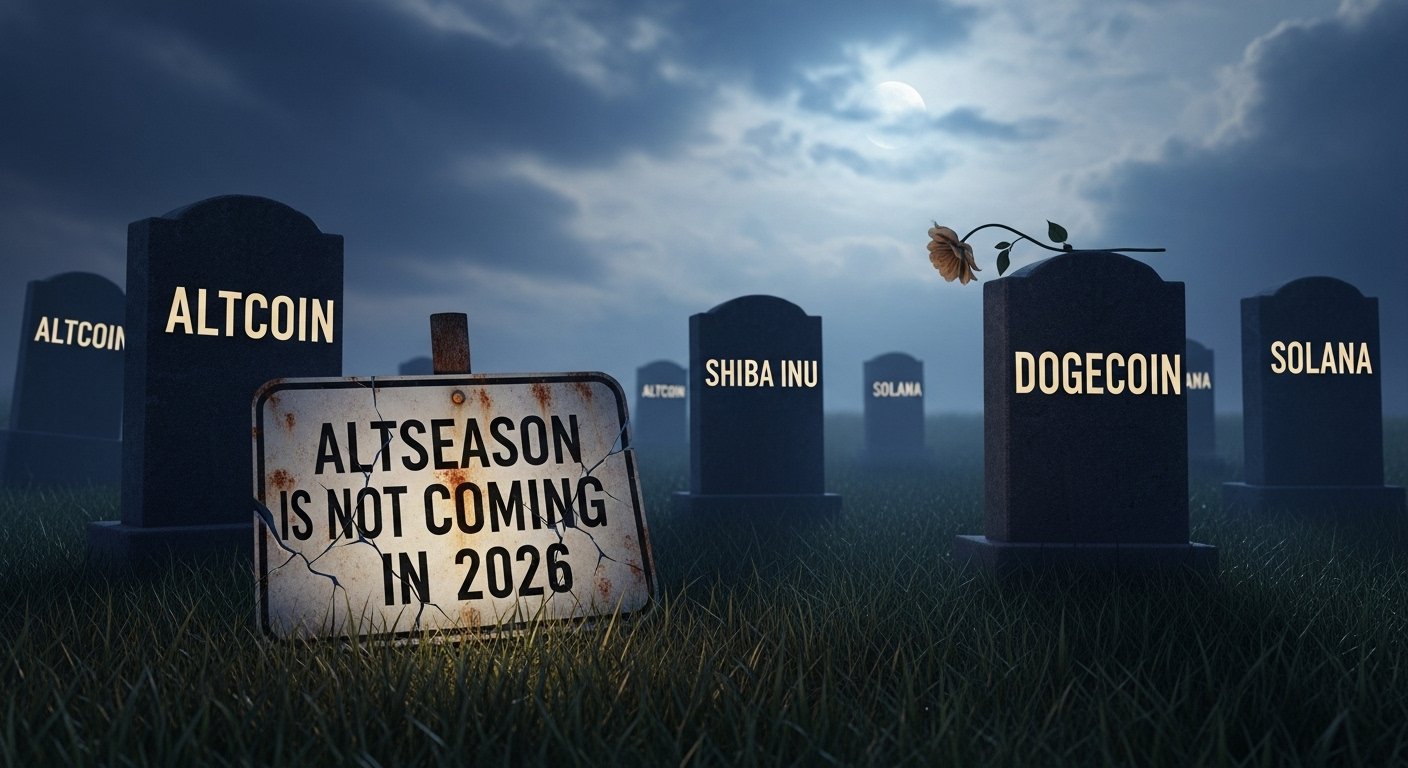
Altseason not coming in 2026, but the harsh reality might be difficult to swallow. For years, crypto investors have relied on predictable market cycles where Bitcoin rallies first, followed by a spectacular surge in alternative cryptocurrencies. However, the landscape has fundamentally changed, and understanding why altseason is not coming in 2026 could save you from devastating portfolio losses. The traditional four-year cycle that once governed cryptocurrency markets appears to be breaking down, and the forces that previously propelled thousands of altcoins to astronomical gains are conspicuously absent in today’s market environment.
The dream of catching the next hundred-times return on obscure altcoins is facing unprecedented challenges. Between regulatory crackdowns, market maturation, and fundamental shifts in investor behavior, the conditions that historically created altcoin season have evaporated. This comprehensive analysis will explore the concrete reasons why the anticipated altcoin rally is failing to materialize and what this means for your cryptocurrency market cycle expectations moving forward.
The Broken Promise of Traditional Market Cycles
For nearly a decade, cryptocurrency investors operated under a relatively predictable framework. Bitcoin would lead the charge during bull markets, establishing new price highs and capturing mainstream attention. Once Bitcoin began consolidating, capital would systematically flow into large-cap altcoins like Ethereum, then mid-cap projects, and finally into small-cap speculative tokens. This cascading effect created the euphoric periods known as altcoin season, where portfolios could double or triple within weeks.
The 2017 bull run exemplified this pattern perfectly. After Bitcoin reached nearly twenty thousand dollars, Ethereum surged from less than ten dollars to over fourteen hundred dollars. Ripple, Litecoin, and countless other alternative cryptocurrencies experienced similar parabolic moves. The 2020 to 2021 cycle repeated this pattern, with DeFi tokens, NFT projects, and meme coins capturing speculative frenzy as Bitcoin stabilized above sixty thousand dollars.
However, the current market cycle refuses to follow this established script. Despite Bitcoin reaching new all-time highs above one hundred thousand dollars in late 2024, the anticipated flood of capital into altcoins has been conspicuously absent. The crypto market trends of previous cycles are not repeating, and this deviation signals something fundamentally different about the current investment landscape.
Bitcoin Dominance Reaches Unprecedented Levels
One of the most striking indicators that altseason is not coming in 2026 is the relentless increase in Bitcoin dominance. This metric, which measures Bitcoin’s market capitalization relative to the total cryptocurrency market, has climbed to levels not seen since 2021. Historically, declining Bitcoin dominance coincided with explosive altcoin rallies, as investors rotated profits from Bitcoin into higher-risk, higher-reward alternative assets.
Today’s market tells a different story. Institutional investors, who now represent a massive portion of cryptocurrency capital, demonstrate clear preferences for Bitcoin over altcoins. The approval of Bitcoin exchange-traded funds in the United States has channeled billions of dollars exclusively into Bitcoin, creating powerful buying pressure that bypasses altcoins entirely. These institutional flows represent sticky, long-term capital rather than the speculative hot money that previously fueled the altcoin season.
The introduction of Bitcoin ETFs has fundamentally altered market dynamics. Traditional finance investors can now gain Bitcoin exposure through familiar brokerage accounts without touching altcoins. This development creates a structural barrier preventing the capital rotation that historically ignited altcoin rallies. When pension funds, hedge funds, and wealth managers allocate to cryptocurrency, they overwhelmingly choose Bitcoin for its liquidity, regulatory clarity, and established track record.
Regulatory Pressure Crushing Altcoin Innovation
The regulatory environment surrounding alternative cryptocurrencies has deteriorated dramatically since the previous bull market. The Securities and Exchange Commission’s aggressive enforcement actions against prominent altcoin projects have created a chilling effect across the industry. Major exchanges have delisted dozens of tokens to avoid regulatory scrutiny, dramatically reducing liquidity and accessibility for retail investors.
The collapse of FTX and subsequent criminal prosecution of its leadership intensified regulatory attention on cryptocurrency markets. Enforcement actions against Binance, Coinbase, and other major platforms have specifically targeted altcoin trading and staking services. This regulatory pressure makes launching new altcoin projects increasingly risky and expensive, reducing the supply of new speculative opportunities that previously characterized the altcoin season.
International regulatory coordination has also tightened considerably. The European Union’s Markets in Crypto-Assets regulation imposes stringent requirements on token issuers and service providers. Similar frameworks are emerging across Asia and other markets, creating global headwinds for altcoin investment that did not exist during previous cycles. Projects that might have thrived in regulatory gray areas now face compliance costs and legal risks that make them economically unviable.
The Death of Retail FOMO and Speculative Mania
Previous altcoin seasons were fueled by retail investor fear of missing out, amplified through social media and cryptocurrency-specific platforms. The 2017 and 2021 cycles saw millions of new retail investors flooding into cryptocurrency markets, often allocating substantial portions of their portfolios to speculative altcoins based on incomplete information and hype-driven narratives.
The crypto market trends of 2026 reveal a dramatically different retail investor profile. After experiencing devastating losses during the 2022 bear market, retail investors have become significantly more risk-averse and skeptical of altcoin promises. The countless failed projects, exit scams, and tokens that declined ninety-nine percent from their peaks have created a scarred generation of investors who no longer blindly chase the next supposed revolutionary blockchain project.
Social media dynamics have also shifted. Cryptocurrency influencers who once commanded massive audiences promoting obscure altcoins now face intense scrutiny and reduced engagement. Regulatory actions against influencers for undisclosed promotional activities have made paid endorsements riskier and less effective. The viral mechanisms that once spread altcoin narratives across Twitter, YouTube, and Telegram have weakened considerably.
Furthermore, competing speculative opportunities have fragmented retail attention and capital. Artificial intelligence stocks, sports betting, and other high-risk investment vehicles compete for the same speculative dollars that previously flowed exclusively into cryptocurrency markets. The cultural monopoly that cryptocurrency enjoyed during previous cycles has dissipated.
Venture Capital Funding Collapse and Project Quality
The altcoin ecosystem relies heavily on venture capital funding to develop projects during bear markets, creating the foundation for potential rallies during bull cycles. However, cryptocurrency-focused venture capital activity has plummeted compared to 2021 and 2022 levels. According to industry data, venture funding for cryptocurrency projects declined over seventy percent between 2022 and 2024, with early 2026 figures showing minimal recovery.
This funding drought has multiple consequences for why altseason is not coming in 2026. First, fewer high-quality projects are launching with adequate resources to build genuine technological innovation or user adoption. The projects that do launch often resort to aggressive token economics designed to enrich early investors rather than create sustainable value. Second, existing projects that raised capital during previous cycles have burned through their runways without achieving meaningful traction, leading to project abandonments and team departures.
The quality degradation is particularly evident in decentralized finance and layer-one blockchain projects. During the previous cycle, dozens of well-funded teams attempted to build “Ethereum killers” with billions in market capitalization despite minimal actual usage. Most of these projects have failed to deliver on technical promises or attract developers and users away from established platforms. Investors have grown weary of revolutionary claims unsupported by fundamental adoption metrics.
Ethereum’s Underperformance Signals Broader Altcoin Weakness
Ethereum’s price performance relative to Bitcoin provides perhaps the clearest signal that altcoin season dynamics have fundamentally changed. Historically, Ethereum’s strength against Bitcoin preceded broader altcoin rallies, as capital flowing into the second-largest cryptocurrency eventually cascaded into smaller assets. However, Ethereum has significantly underperformed Bitcoin throughout the current cycle, failing to establish new all-time highs even as Bitcoin surged past previous records.
This underperformance is particularly noteworthy given Ethereum’s successful transition to proof-of-stake and ongoing technical improvements. If Ethereum, with its established developer ecosystem, institutional adoption, and network effects, cannot maintain strength against Bitcoin, smaller altcoins face even more challenging headwinds. The Ethereum-to-Bitcoin ratio has declined substantially, breaking key support levels that previously held during bull markets.
Several factors contribute to Ethereum’s relative weakness and its implications for broader crypto market trends. Layer-two scaling solutions, while technically successful, have fragmented liquidity and attention across multiple platforms rather than concentrating value in the Ethereum base layer. Competition from alternative smart contract platforms has intensified, though none have achieved breakthrough adoption. Most significantly, the narrative around Ethereum has shifted from revolutionary technology to utility infrastructure, reducing its appeal to speculative investors seeking exponential returns.
The Meme Coin Phenomenon and Capital Fragmentation
An unexpected development in the current cycle has been the persistent popularity of meme coins, which paradoxically demonstrates why traditional altcoin investment is struggling. Meme coins like Dogecoin and newer entrants have captured speculative attention and capital that might have previously flowed into utility-focused altcoin projects. This represents a fundamental shift in speculative preferences.
Meme coins offer transparent value propositions based purely on community and narrative rather than technical promises that frequently disappoint. After experiencing countless failed “revolutionary” blockchain projects, some speculative investors prefer the honest absurdity of meme coins over technically complex projects with dubious utility. This capital allocation represents a form of cynical sophistication that undermines traditional altcoin narratives.
The success of meme coins also fragments available speculative capital across hundreds or thousands of competing tokens, preventing the concentrated flows that characterized previous altcoin seasons. Rather than capital systematically flowing from Bitcoin to Ethereum to large-cap altcoins to small-cap projects, speculative capital now disperses unpredictably across meme coins, with individual tokens experiencing brief pumps before collapsing. This fragmentation prevents the sustained, broad-based rallies that defined traditional altcoin season.
Macroeconomic Conditions and Interest Rate Environment
The macroeconomic backdrop for cryptocurrency markets has transformed dramatically since the previous bull cycle. The era of zero interest rates and unlimited quantitative easing that characterized the 2020 to 2021 period has been replaced by restrictive monetary policy and elevated interest rates. This shift fundamentally alters risk asset dynamics and investor behavior across all markets, including cryptocurrencies.
During zero-interest-rate environments, investors faced minimal opportunity cost for holding speculative assets. Capital flooded into risky investments seeking returns unavailable from traditional fixed-income securities. The current environment offers competitive yields from treasury securities and money market funds, creating meaningful opportunity costs for speculative alternative cryptocurrencies. Rational investors can now achieve four to five percent annual returns from virtually risk-free instruments, raising the bar for justifying exposure to volatile altcoins.
The macroeconomic environment also affects the leveraged speculation that previously amplified altcoin season dynamics. Higher interest rates increase the cost of leveraged positions, reducing the availability of margin and derivative products that magnified altcoin price movements. The deleveraging that occurred during the 2022 bear market has not been replaced by new speculative leverage, limiting the explosive price movements characteristic of previous cycles.
The Rise of Bitcoin-Only Maximalism
A cultural and philosophical shift within the cryptocurrency community has strengthened Bitcoin-focused ideology at the expense of altcoin enthusiasm. Bitcoin maximalism, the view that Bitcoin represents the only legitimate cryptocurrency with all altcoins being distractions or scams, has gained adherents and intellectual credibility during recent years. This ideological shift influences capital allocation decisions and narrative dominance within the cryptocurrency space.
Prominent voices within the cryptocurrency community increasingly promote Bitcoin-only portfolios, arguing that altcoins represent unnecessary risks without commensurate benefits. This perspective has gained traction following the collapse of numerous high-profile altcoin projects and the regulatory classification of many tokens as unregistered securities. The intellectual framework supporting altcoin investment has weakened considerably as Bitcoin’s unique properties and regulatory clarity become more apparent.
The Bitcoin-only narrative particularly resonates with institutional investors and high-net-worth individuals entering cryptocurrency markets for the first time. These sophisticated investors often view altcoins skeptically, recognizing that most lack genuine decentralization, security, or network effects comparable to Bitcoin. As institutional capital represents an increasingly large portion of cryptocurrency markets, the dominance of Bitcoin-focused allocation strategies creates structural headwinds preventing traditional altcoin season dynamics.
NFT Market Collapse and Lost Speculative Avenue
The non-fungible token market, which represented a significant driver of altcoin demand during the previous cycle, has collapsed dramatically. NFT projects required Ethereum and other altcoins for minting, trading, and participating in digital collectible markets. The NFT boom created substantial demand for blockchain native tokens beyond pure speculative trading.
The NFT market’s decline eliminated this source of organic altcoin demand. Trading volumes on major NFT marketplaces have fallen over ninety percent from peak levels, with most collections losing the majority of their value. The speculative mania that drove individuals to spend hundreds of thousands of dollars on digital artwork has evaporated, replaced by widespread acknowledgment that most NFTs lack fundamental value or utility.
This collapse represents more than just one speculative sector declining. It demonstrates the broader exhaustion of narrative-driven cryptocurrency speculation that characterized previous cycles. Each cryptocurrency bull market has been associated with a dominant narrative, whether initial coin offerings in 2017, decentralized finance in 2020, or NFTs and metaverse projects in 2021. The current cycle lacks a compelling new narrative capable of driving speculative enthusiasm and capital into alternative cryptocurrencies.
What This Means for Cryptocurrency Investors in 2026
Understanding that altseason is not coming in 2026 requires investors to fundamentally reassess portfolio strategies and expectations. The traditional approach of accumulating diverse altcoin portfolios during bear markets in anticipation of explosive bull market gains appears increasingly obsolete. Instead, successful cryptocurrency investing in the current environment demands different frameworks and risk management approaches.
Concentration in established assets with genuine adoption and regulatory clarity represents a more prudent approach than diversification across speculative altcoins. Bitcoin and potentially Ethereum offer liquidity, institutional support, and clearer regulatory pathways than the vast majority of alternative cryptocurrencies. While this concentration may limit upside potential compared to perfectly timing obscure altcoins, it substantially reduces the risk of catastrophic losses that have devastated altcoin-heavy portfolios.
Investors maintaining altcoin exposure should apply significantly more rigorous evaluation criteria than during previous cycles. Genuine user adoption, sustainable business models, experienced teams with demonstrated execution capabilities, and realistic token economics should replace hype-driven narratives and technical promises. The days of indiscriminately accumulating tokens based on influencer recommendations or social media trends have ended for rational investors.
The psychological adjustment may be the most challenging aspect of accepting that altseason is not coming in 2026. Many cryptocurrency investors built their entire investment thesis around catching the next altcoin season, dedicating years to researching projects and building positions. Abandoning this framework requires acknowledging that market conditions have fundamentally changed and that past patterns may not repeat. This acceptance, while difficult, is essential for avoiding the denial that leads to holding declining assets indefinitely.
Alternative Investment Strategies for the Current Market
Rather than waiting for an altcoin season that may never arrive, sophisticated investors are adapting strategies to current market realities. Bitcoin accumulation strategies, including dollar-cost averaging and strategic buying during market corrections, have replaced altcoin speculation for many serious investors. The introduction of Bitcoin ETFs has made these strategies more accessible and tax-efficient for traditional investors.
Some investors are exploring Bitcoin-focused derivative strategies that can generate returns in sideways or declining markets through covered calls, cash-secured puts, and other option strategies. These approaches provide income generation and risk management capabilities unavailable through simple buy-and-hold altcoin strategies. The maturation of cryptocurrency derivatives markets has made these sophisticated strategies increasingly viable.
For investors unwilling to completely abandon alternative cryptocurrencies, concentrated positions in a small number of established projects with genuine adoption may offer better risk-adjusted returns than broad altcoin diversification. Ethereum, despite its underperformance relative to Bitcoin, maintains substantial developer activity and institutional adoption. Select layer-one platforms with demonstrated user bases and unique value propositions may warrant small portfolio allocations, though expectations should be tempered compared to previous cycles.
The emergence of Bitcoin layer-two solutions and side chains represents a potential middle ground between Bitcoin maximalism and traditional altcoin investing. Projects building genuine infrastructure and applications on Bitcoin may capture value as Bitcoin adoption increases, without the regulatory risks and competitive dynamics facing standalone altcoin platforms. This represents a relatively unexplored investment category that aligns with Bitcoin-focused capital flows while offering potential upside beyond simple Bitcoin appreciation.
Conclusion
The evidence overwhelmingly suggests that altseason is not coming in 2026 as previous market cycles would predict. The convergence of regulatory pressure, institutional Bitcoin preference, retail investor sophistication, macroeconomic headwinds, and cultural shifts has fundamentally altered cryptocurrency market dynamics. Investors clinging to outdated frameworks risk substantial capital losses as they wait for market conditions that may never materialize.
This reality requires honest reassessment of cryptocurrency investment strategies. The explosive, indiscriminate altcoin rallies that characterized 2017 and 2021 appear to be artifacts of unique historical moments rather than recurring patterns investors can reliably exploit. The maturation of cryptocurrency markets has created winners and losers, with Bitcoin cementing its position as digital gold while most alternative cryptocurrencies struggle for relevance and value proposition.
However, this evolution does not necessarily mean cryptocurrency investing lacks opportunity. Rather, it demands more sophisticated analysis, higher quality standards, and realistic expectations. The days of hundred-times returns from random altcoins have likely ended for all but the luckiest speculators, but cryptocurrency as an asset class continues evolving and potentially offers value within appropriately constructed portfolios.
Understanding why altseason is not coming in 2026 positions investors to make rational decisions rather than emotional ones based on past glory stories. The cryptocurrency market is growing up, and successful investors must grow with it. Are you ready to adjust your strategy for the new cryptocurrency reality, or will you continue waiting for an altcoin season that may never arrive? The choice you make today will determine your portfolio’s fate in the years ahead.
See more; Altseason Index 2025 High: Altcoins Near Record Market Cap
