


The crypto market just endured one of its sharpest shakeouts in months. On Friday, Bitcoin (BTC) plunged in a fast, cascading sell-off that rippled across the entire crypto market and liquidated billions in leveraged positions. Headlines linked the downdraft to fresh trade-war headlines and a broader risk-off move, sending BTC briefly careening toward six figures before a weekend rebound. By Monday, Bitcoin had clawed back a chunk of the losses, but the scar tissue remains: traders are openly debating whether BTC bears will press their advantage and force a decisive test of the psychological $100,000 level—or whether dip buyers have already turned the flush into a springboard for the next leg higher.
This piece examines what happened during Friday’s crash, why macro catalysts may still matter more than ever, and which BTC price levels and metrics could determine whether the next significant move is lower, toward $100K, or higher back toward the prior range. We’ll also explore on-chain metrics, derivatives positioning, and support and resistance zones that matter for both short-term traders and long-term allocators.
What really triggered Friday’s Bitcoin flash crash?
Friday’s rout didn’t occur in a vacuum. The immediate catalyst was an escalation in U.S.–China trade tensions—policy headlines that hit risk assets broadly and sparked a disorderly deleveraging across crypto derivatives. When macro fear collides with crowded positioning, the result is often a liquidation cascade, and that’s exactly what unfolded: billions in crypto longs were wiped out as BTC dropped double digits within hours and major altcoins fell even harder. Multiple outlets tied the downdraft to renewed tariff threats, with the shock reverberating through derivatives funding, open interest, and liquidity pockets that had grown shallow after a strong run-up.
Although Bitcoin quickly rebounded from the lows into the new week, the snapback may say more about the market’s reflexive dip-buying culture than about the underlying fragility revealed by the cascade. A “V-shaped” bounce can be bullish, but when it follows forced selling, it often leaves a patchwork of trapped longs and thin order books—conditions that can amplify the next move in either direction. As of Monday, reports pegged BTC’s rebound at roughly 12% off the weekend trough, underscoring both the market’s resilience and its ongoing volatility.
Why $100,000 looms as the battleground
The psychology of round numbers in BTC
Round numbers matter in markets, and $100,000 is more than just a price tag—it’s a psychological threshold. For months, spot flows, ETF demand, and a supportive macro narrative helped BTC establish itself well above the six-figure mark. But when a violent drawdown drags price toward that boundary, traders reflexively frame the next move as a binary: either the level holds and becomes a launchpad, or it breaks and becomes a magnet for momentum shorts.
From an order-flow perspective, round-number levels concentrate stop losses and resting liquidity. If bears can push price through $100K on high volume, the resulting stop-run could extend the move before responsive buyers step in. Conversely, if bulls repeatedly absorb sell pressure just above six figures, sellers can run out of ammunition and fuel a squeeze higher.
Technical levels that define the near-term tape
On the charts, the key question is whether former demand zones—roughly the mid-$110Ks to low-$120Ks—flip into supply on rallies. Friday’s break smashed through several short-term moving averages and exposed the market to a deeper test of the summer basing area near $105K–$108K. Some analyst notes and weekend recaps highlighted intraday prints close to $102,000–$106,000 during the flush before BTC snapped back above $110K into Monday trade. That bounce is constructive, but the market still needs to prove it can sustain closes back above the breakdown area to neutralize the bear case.
If bulls fail to reclaim those ranges, there’s a credible path to a full retest of $100,000. And if that level gives way decisively, prior high-volume nodes in the mid-$90Ks could come into play. None of this is preordained—but when liquidations spike and confidence wobbles, price tends to gravitate toward the next big pool of liquidity.
Macro still matters: tariffs, yields, and liquidity
Trade-war headlines and cross-asset volatility
Crypto doesn’t trade in isolation. Renewed tariff threats raised uncertainty around global growth, corporate margins, and supply chains. In traditional markets, such shocks typically push investors toward defensive positioning, widen credit spreads, and increase demand for dollars—conditions that can pressure risk assets, including BTC. Reports over the weekend repeatedly pointed to tariff headlines as a proximate cause of the crash, a reminder that Bitcoin’s correlation to macro catalysts can surge during stress regimes.
Liquidity regime and the “risk budget”
Beyond the headline of the day, the deeper driver is the global liquidity regime. When real yields rise and financial conditions tighten, speculative risk budgets shrink. That doesn’t mean Bitcoin can’t rally—only that rallies are more fragile, more dependent on incremental spot demand, and more vulnerable to leverage unwinds. Conversely, when policy pivots toward easing, spot ETFs, stablecoin issuance, and institutional flows can accelerate upside.
Market commentators have argued both sides of the liquidity debate this month—some suggesting expanding fiat liquidity reduces crash risk, others warning that valuations across assets look stretched and vulnerable. The upshot for Bitcoin is simple: if liquidity tightens and volatility stays elevated, bears have a cleaner setup to force a showdown at $100K.
Inside the crash: leverage, liquidations, and market structure
How liquidations amplified the sell-off
Derivatives are the beating heart of crypto price discovery. On Friday, once BTC lost key intraday supports, a wave of long liquidations accelerated the drop. Estimates from market trackers framed it as one of the largest single-session liquidation events of the year by notional value, with BTC leading the way and altcoins absorbing heavier percentage losses. These wipes are a feature, not a bug, of crypto derivatives markets: when funding turns positive for too long and open interest swells, leverage becomes dry tinder. One spark—this time macro—can set it ablaze.
Liquidity holes and thin order books
During the rally, order books often looked deceptively deep; in reality, much of the displayed liquidity was fleeting. As prices fell, market-makers widened spreads and retreated, leaving “air pockets” where prices skipped multiple levels with little resistance. This is why the tape looked waterfall-like on Friday, and why rebound attempts can snap back violentlyly, too. For swing traders, this environment rewards patience and disciplined entries around well-defined levels rather than chasing momentum.
On-chain and flow signals to watch
Long-term holders vs. short-term speculators
A bright spot during the drop: long-term holders did not panic into weakness. Several weekend analyses observed that wallets dormant for months remained inactive, while whale wallets opportunistically added on the dip. Retail flows, by contrast, were whipsawed by the speed of the move. When long-term cohorts hold steady into a drawdown, it reduces the risk of a full-blown distribution phase and increases the odds that forced sellers exhaust themselves more quickly.
Exchange flows, funding, and basis
Keep an eye on net exchange flows. Sustained inflows often foreshadow sell pressure as coins move from cold storage to venues where they can be sold. Outflows, especially after a crash, can signal renewed conviction as investors scoop up coins and withdraw them to custody. In derivatives, a reset toward neutral or negative funding rates after a liquidation flush is typical; if funding heats up too soon on a weak bounce, it can set the stage for another push lower. The futures basis—the spread between spot and futures—also tends to compress after a wipeout. A re-expansion of basis on a rising spot price is a healthier sign that real demand is returning.
The bear case: How BTC could break $100K
A failed retest of resistance
If BTC can’t reclaim the breakdown area in the low-to-mid $120Ks, every rally risks becoming a “sell the bounce” opportunity. Support and resistance tend to flip roles after a decisive break; what was once a floor becomes a ceiling. A series of lower highs against that ceiling would embolden bears to press for a full retest of the round number.
Another macro shock
Markets rarely price one headline at a time. Beyond trade tensions, any fresh shock—hot inflation, sticky real yields, geopolitics—could sap risk appetite again. If traditional markets wobble and the dollar firms, crypto’s correlation to macro could spike, amplifying downside. Friday’s tape showed how quickly that transmission can occur.
Liquidity fracture and a second liquidation wave
Post-crash liquidity is fragile. If price grinds lower and funding warms back up, a precarious mix of complacency and leverage can build beneath the surface. A fresh catalyst could then trigger a second liquidation wave—smaller than Friday’s, but sufficient to trip the last lines of defense above $100,000.
The bull case: Why $100K may hold
Structural demand from spot buyers
Under the surface, structural spot demand—whether from spot ETFs, corporate treasuries, or long-only crypto funds—tends to increase on weakness. These players are less sensitive to intraday noise and more focused on multi-quarter horizons. Their bids don’t always appear in the order book, but they provide a backstop that makes protracted breakdowns more difficult unless macro truly deteriorates.
Long-term holder behavior and supply dynamics
If long-term holders continue to sit tight and miners avoid aggressive selling, the liquid float available to satisfy panic supply shrinks. Add in routine stablecoin issuance and on-chain evidence of accumulation, and the path of least resistance can shift back upward once volatility subsides. Weekend commentary highlighting rising holder counts during the crash is consistent with this narrative.
The anatomy of “bear traps”
Bitcoin is famous for punishing consensus. After a high-profile crash, the consensus often becomes “we must retest $100K.” Markets love to front-run obvious levels; if bears pile in too heavily below $110K expecting the breakdown, a modest positive surprise—better macro headline, renewed ETF inflow—can spring a bear trap that squeezes price back toward the prior range.
Trading the tape: strategy notes for different timeframes
For short-term traders
Short-term traders should focus on the reaction, not the prediction. The invalidation for a bearish push sits near the recent breakdown pivot; sustained closes back above that zone weaken the bear case and favor mean reversion higher. Until that happens, treat bounces into former support as a suspect. Watch funding, open interest, and cumulative volume delta for signs of forced buying versus fresh spot demand. A clean break and hold below $105K–$108K would open the runway to a $100K test.
For swing traders
The swing-trader playbook is patience. Define the box: roughly $100–$120K. Fade edges, don’t chase middles. If price revisits $100K with clear seller exhaustion (falling volume, positive divergences, rising RSI while price holds flat), partial entries with tight risk may be justified. Conversely, if price presses into $120K with rising funding and little spot confirmation, trim risk and wait for acceptance above to add.
For long-term allocators
For allocators with multi-year horizons, crashes are a feature of the asset class. The prudent approach is systematic: dollar-cost average, size positions relative to volatility, and respect risk management. If Bitcoin’s thesis—digital, scarce, globally transferable collateral—remains intact, cyclical drawdowns are the price of long-run upside. That said, be honest about your time horizon and your tolerance for 20%+ swings.
Sentiment and narrative: what the crowd believes now
Narrative whiplash is normal after a flash crash. Over the weekend, “sell-everything” took competed wbuy-the-dip” bravado. Some commentators argued that expanding liquidity trends should make deep crashes less likely, while others warned that valuations across risk assets were stretched even before Friday. The truth may lie in between: Bitcoin can rally powerfully within a choppy macro, but the path will be jagged, not straight. For traders, that means staying humble. For allocators, it means sticking to process over prediction.
What would confirm a true breakdown toward $100K?
Failure to reclaim the breakdown area
If BTC fails multiple retests of the low-$120Ks and prints lower highs, the market will interpret each rally as distribution. Watch for rejection wicks and rising volume on down days.
Expansion in realized volatility with negative skew
A renewed spike in realized volatility alongside a steepening downside skew in options implies traders are paying up for protection. That mix often accompanies trend extensions, not reversals.
Renewed exchange inflows from long-term cohorts
If long-term holders begin sending coins to exchanges—a sign of distribution rather than accumulation—the path to $100K becomes easier. Metrics tracking whale wallets and dormancy will be especially informative in the days ahead.
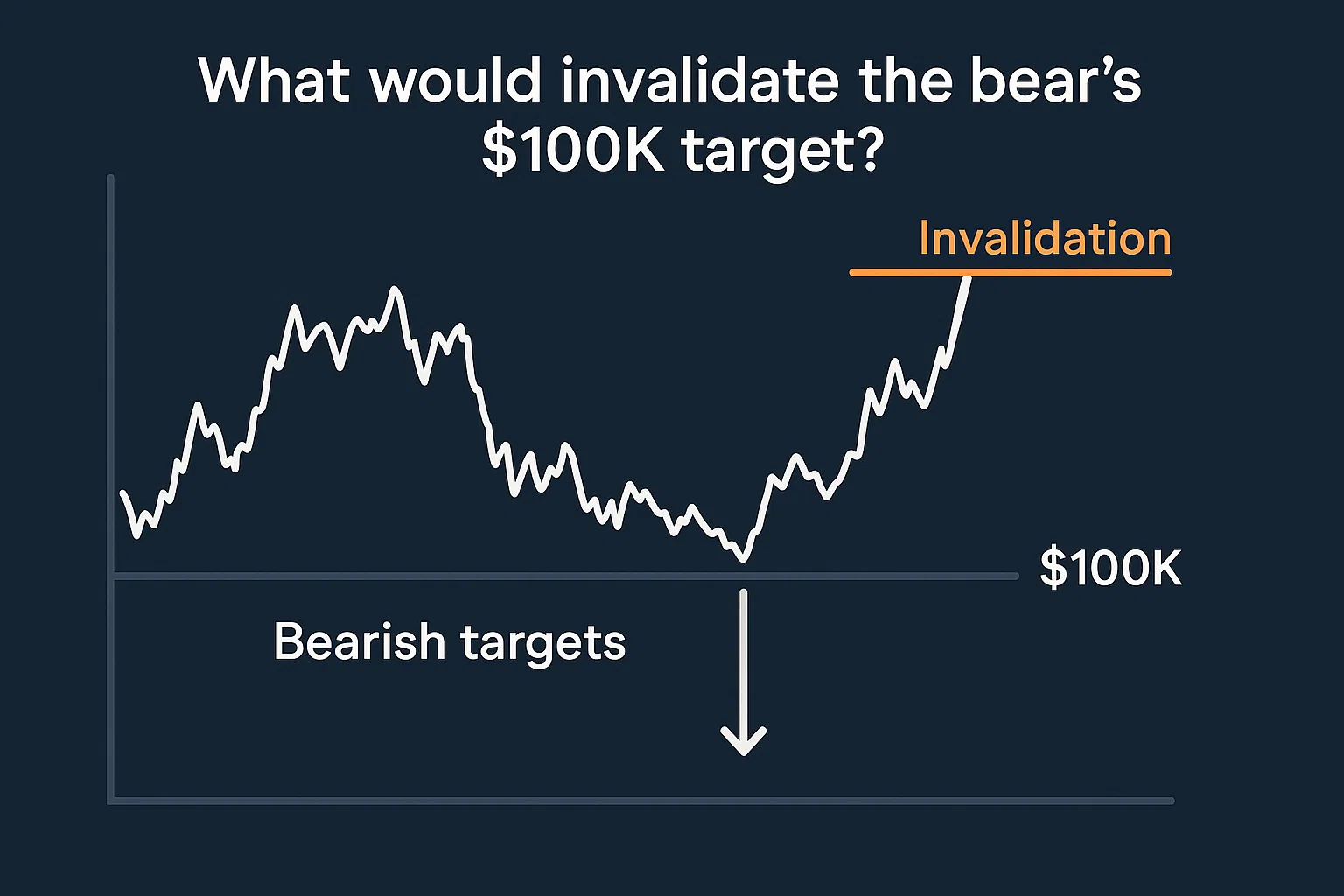
What would invalidate the bear’s $100K target?
Acceptance back into the prior range
Multiple daily closes back above the breakdown area, ideally with growing spot volumes and a cooling of funding rates, would argue the flush was an aberration rather than a regime change.
Re-expanding futures basis with light leverage
A healthy bull advance usually sees futures basis re-expand even as absolute open interest stays contained. That’s the signature of real demand, not simply hot money.
Positive on-chain shifts
If exchange outflows resume, active addresses tick up, and long-term holder supply hits new highs, the structural bid should reassert, making a sustained break of $100,000 less likely.
The human toll: risk, responsibility, and perspective
It’s easy to reduce Friday’s events to candles and charts. But beyond the tick-by-tick, sudden market crashes can have real human consequences—especially for those trading with high leverage or with money they can’t afford to lose. Over the weekend, tragic news out of Kyiv underscored this reality and sparked conversations about mental health and responsible trading. Markets will always be here tomorrow. Protect capital—and yourself—first.
See More: 10 Safest Cryptocurrencies to Invest in 2025 Guide
Conculsion
After Friday’s crash, bears have a coherent roadmap to press BTC toward $100,000: a failure to reclaim the breakdown area, persistent macro headwinds from trade tensions and yields, fragile liquidity, and a derivatives market still nursing bruises from historic liquidations. Bulls, for their part, can defend $100K if structural spot demand reasserts, long-term holders keep supply tight, and price recaptures lost territory with conviction.
In a market this reflexive, prediction is less valuable than preparation. If you’re short-term, trade the levels and the reaction. If you’re long-term, respect volatility, avoid leverage, and let process—not headlines—drive your decisions.
Frequently Asked Questions
Q: Did Friday’s crash change Bitcoin’s long-term trend?
Not necessarily. A single flash crash driven by macro headlines and leverage liquidations doesn’t automatically end a longer-term uptrend. What matters is what follows: can BTC reclaim the breakdown area and attract sustained spot demand? If yes, the long-term structure remains intact. If not, a deeper retrace toward $100K is on the table.
Q: Why is $100,000 such an important level for BTC?
It’s a round-number magnet for liquidity and psychology. Many stop losses, options strikes, and discretionary decisions cluster around such levels. Breaking below $100K could trigger additional momentum selling, while repeated defenses can squeeze shorts and produce sharp rebounds.
Q: What on-chain signals should I watch this week?
Focus on exchange inflows/outflows, long-term holder activity, and whale wallets. Rising exchange balances after a crash suggest potential distribution; falling balances imply accumulation. Also monitor funding rates and futures basis to distinguish real demand from hot leverage.
Q: How did macro headlines cause such a big crypto move?
Trade-war announcements jolted risk assets and tightened financial conditions at the margin. In crypto, where open interest and leverage were elevated, that shock catalyzed a liquidation cascade. The result: one of the largest single-day notional liquidations of the year and a rapid price drop across BTC and altcoins.
Q: Is the worst over, or could we see another leg down?
Volatility after a major flush often remains elevated. If BTC can’t reclaim lost territory and macro stays shaky, a retest of $100,000 is plausible. Conversely, if spot inflows rebuild and the market accepts price back into the prior range, the lows may already be in. As always, align strategy with timeframe and risk tolerance—and avoid excessive leverage.
