

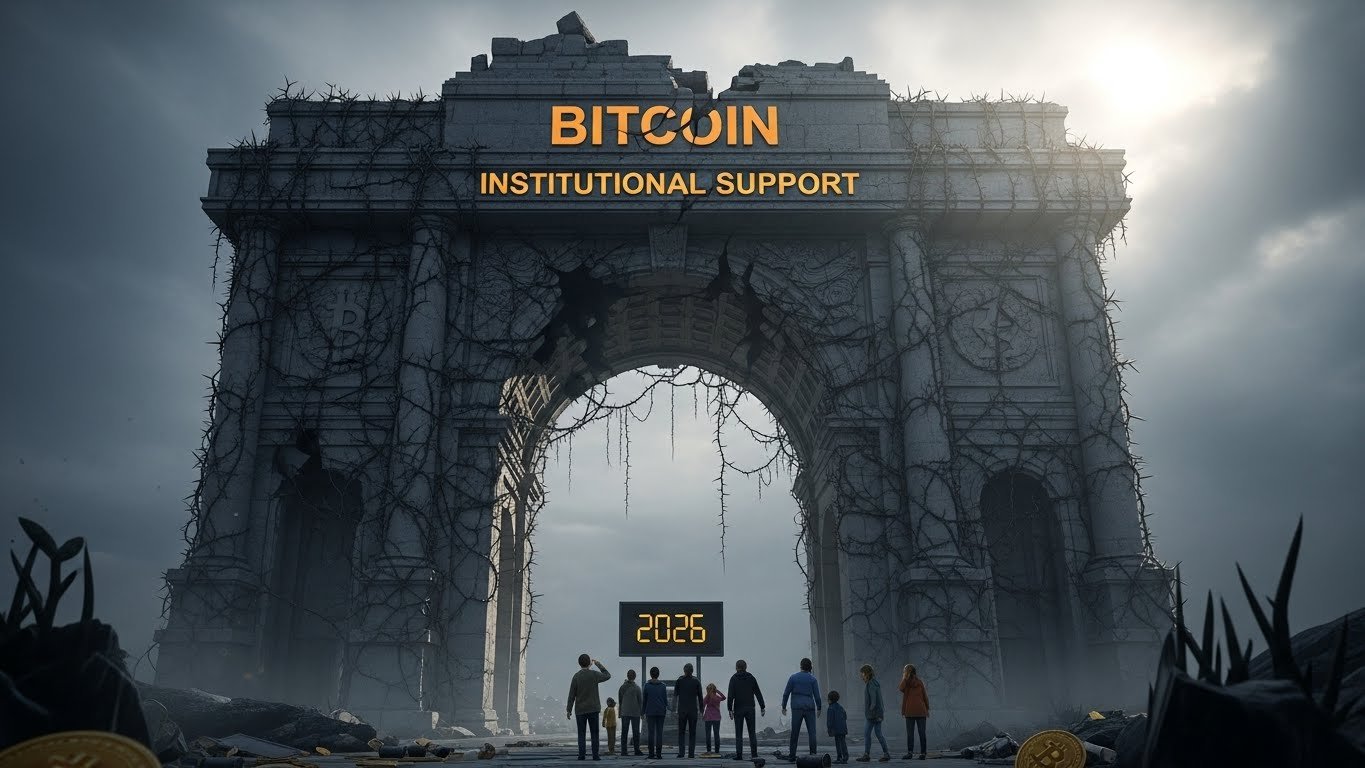
Bitcoin institutional support continues to grow with major financial entities entering the market, the flagship digital currency remains stubbornly weak, hovering below key psychological price levels. This disconnect between institutional adoption and market performance has left both retail and professional investors questioning the validity of long-held bullish narratives. The current Bitcoin institutional support weakness phenomenon represents a critical moment in cryptocurrency history, challenging the assumption that institutional participation alone can drive sustainable price appreciation and market stability.
Understanding why Bitcoin remains weak despite institutional support requires examining multiple dimensions of market dynamics, from macroeconomic pressures to regulatory uncertainties and shifting investor sentiment. This comprehensive analysis explores the complex relationship between institutional backing and market performance, offering insights into what this means for the future of digital assets.
Bitcoin Institutional Support in Today’s Market
Bitcoin institutional support has evolved dramatically since the cryptocurrency’s inception. What began as a niche investment vehicle for tech enthusiasts has transformed into a legitimate asset class attracting Fortune 500 companies, hedge funds, and even sovereign wealth funds. Major institutions like BlackRock, Fidelity, and Grayscale have launched Bitcoin-focused investment products, signaling mainstream acceptance of digital currencies.
The approval of spot Bitcoin exchange-traded funds (ETFs) in early 2024 marked a watershed moment for cryptocurrency legitimacy. These financial instruments provided traditional investors with regulated exposure to Bitcoin without the complexities of self-custody. Within weeks of their launch, Bitcoin ETFs accumulated billions in assets under management, demonstrating substantial institutional appetite for cryptocurrency exposure.
However, the influx of institutional capital hasn’t translated into the price stability or appreciation many anticipated. Despite record levels of institutional Bitcoin adoption, the cryptocurrency has experienced significant volatility and prolonged periods of weakness. This disconnect raises fundamental questions about the relationship between institutional participation and market performance.
The Scale of Institutional Investment in Bitcoin
Current data reveals that institutional investors now hold approximately 20-25% of the total Bitcoin supply. Major publicly traded companies including MicroStrategy, Tesla, and Square maintain substantial Bitcoin treasury positions. Mining operations have industrialized, with publicly listed companies operating massive facilities powered by renewable energy sources.
Traditional financial institutions have integrated Bitcoin into their service offerings. Goldman Sachs, JPMorgan, and Morgan Stanley now provide Bitcoin exposure to their wealth management clients. Custody solutions from established financial services companies have made institutional Bitcoin ownership more secure and practical than ever before.
Despite this institutional infrastructure, Bitcoin’s weakness despite institutional backing persists, suggesting that adoption alone cannot overcome broader market forces affecting cryptocurrency valuations.
Why Bitcoin Remains Weak Despite Growing Institutional Backing
The persistence of Bitcoin market weakness in the face of institutional support stems from several interconnected factors that extend beyond simple supply and demand dynamics. Understanding these elements provides crucial context for current market conditions.
Macroeconomic Headwinds Affecting Bitcoin Performance
Global economic conditions have created challenging circumstances for risk assets, including Bitcoin. Central bank policies, particularly from the Federal Reserve, have maintained higher interest rates to combat inflation. This monetary tightening has reduced liquidity in financial markets, decreasing appetite for speculative investments.
Bitcoin institutional support cannot fully insulate the cryptocurrency from broader economic trends. When traditional markets face pressure, institutional investors often reduce exposure to volatile assets, including cryptocurrencies, to manage portfolio risk. The correlation between Bitcoin and technology stocks has strengthened in recent years, meaning that weakness in equity markets frequently translates into Bitcoin price declines.
Rising bond yields have made fixed-income investments more attractive relative to non-yielding assets like Bitcoin. Institutional investors allocating capital across asset classes must justify cryptocurrency positions against competing investment opportunities offering guaranteed returns with lower volatility.
Regulatory Uncertainty Dampening Institutional Confidence
Despite growing institutional Bitcoin adoption, regulatory ambiguity continues to constrain market enthusiasm. Different jurisdictions maintain divergent approaches to cryptocurrency regulation, creating compliance challenges for international institutions. The United States, Europe, and Asia have implemented varying frameworks, forcing institutions to navigate complex legal landscapes.
Recent regulatory enforcement actions against cryptocurrency exchanges and service providers have heightened institutional caution. High-profile legal battles involving major industry participants have created uncertainty about the future regulatory environment. Institutions must balance their interest in Bitcoin exposure against potential compliance risks and regulatory changes.
The absence of comprehensive cryptocurrency legislation in major economies means that institutional participants operate in a partially defined legal framework. This uncertainty affects Bitcoin investor confidence, as institutions require regulatory clarity before committing significant capital to cryptocurrency investments.
Market Structure and Liquidity Concerns
The cryptocurrency market’s relatively small size compared to traditional financial markets creates structural challenges that Bitcoin institutional support cannot immediately resolve. Despite Bitcoin’s multi-hundred-billion-dollar market capitalization, its trading volume and liquidity remain modest compared to major currency or commodity markets.
Large institutional transactions can significantly impact Bitcoin prices due to limited market depth. This creates execution challenges for institutions seeking to establish or exit substantial positions. The resulting price volatility discourages some institutional participants who require more stable asset performance.
Over-the-counter (OTC) trading desks have developed to facilitate large institutional transactions, but these solutions don’t eliminate the fundamental liquidity constraints of the cryptocurrency market. When market stress occurs, liquidity can evaporate rapidly, amplifying price movements and testing investor confidence in Bitcoin.
Testing Investor Confidence: Retail and Institutional Divergence
The current market environment has created a notable divergence between retail and institutional investor behavior, with important implications for Bitcoin’s market performance. Understanding this split provides insight into why the cryptocurrency remains weak despite institutional participation.
Retail Investor Sentiment and Market Psychology
Retail investors, who historically drove Bitcoin adoption and price discovery, have shown increasing caution in recent market cycles. The painful bear market of 2022 and subsequent volatility in 2023-2024 left many retail participants with losses that have shaped their risk appetite. The promise of easy profits that attracted retail investors during previous bull markets has given way to more skeptical assessment of cryptocurrency investment prospects.
Social media sentiment analysis reveals declining enthusiasm among retail cryptocurrency communities. Where previous market cycles generated viral enthusiasm and fear-of-missing-out behavior, current conditions reflect fatigue and disappointment. This shift in retail psychology occurs despite Bitcoin institutional support reaching historic levels, highlighting the disconnect between institutional participation and retail sentiment.
The education level of retail cryptocurrency investors has improved, leading to more sophisticated analysis of market conditions. Retail participants increasingly recognize that institutional Bitcoin adoption doesn’t guarantee short-term price appreciation. This evolved understanding has tempered the euphoric reactions that previously accompanied news of institutional involvement.
Institutional Risk Management and Position Sizing
Institutional investors approach cryptocurrency with fundamentally different risk management frameworks than retail participants. While institutions have entered the Bitcoin market, their position sizes remain relatively conservative within overall portfolio allocations. Most institutional Bitcoin holdings represent 1-5% of total assets under management, limiting their ability to drive significant price appreciation.
Institutional Bitcoin investor confidence is subject to quarterly performance reviews, risk committee oversight, and fiduciary responsibilities that don’t affect retail investors. When Bitcoin underperforms expectations or experiences volatility exceeding predetermined thresholds, institutions must reduce exposure regardless of long-term conviction.
The professionalization of cryptocurrency investment through institutional participation has introduced new market dynamics. Institutions employ sophisticated hedging strategies, derivatives trading, and algorithmic execution that can amplify short-term volatility while seeking to manage risk. These professional trading activities don’t always support price appreciation, even when institutions maintain long-term bullish views.
The Role of Bitcoin ETFs in Current Market Dynamics
Bitcoin exchange-traded funds represent the most visible manifestation of Bitcoin institutional support, yet their impact on price performance has proven more complex than many anticipated. Examining ETF dynamics illuminates broader questions about institutional participation and market strength.
ETF Flows and Price Impact Analysis
Bitcoin spot ETFs launched with tremendous fanfare and initial capital inflows that briefly supported cryptocurrency prices. However, flow patterns have become more volatile, with significant inflows occasionally followed by substantial outflows. This inconsistency reflects changing institutional sentiment and broader market conditions affecting allocation decisions.
The relationship between ETF flows and Bitcoin prices is not straightforward. Positive flows don’t guarantee price appreciation, as ETF issuers may already hold Bitcoin inventory or execute purchases through OTC desks with minimal market impact. Similarly, ETF redemptions don’t always trigger immediate price declines if issuers can satisfy redemptions from existing holdings.
Bitcoin ETF institutional support has created new arbitrage opportunities and market efficiency improvements, but these developments haven’t eliminated price weakness. The availability of regulated ETF products has actually made it easier for institutions to reduce Bitcoin exposure quickly, potentially increasing downside pressure during market stress.
Competition Among Bitcoin Investment Products
The proliferation of Bitcoin investment vehicles has fragmented institutional capital that might otherwise concentrate in the spot market. Futures-based products, trust structures, mining equity exposure, and blockchain technology stocks all compete for institutional cryptocurrency allocation. This diversification of institutional Bitcoin investment options dilutes the price impact of institutional participation.
Different institutional investors prefer different exposure mechanisms based on their regulatory constraints, tax considerations, and risk management requirements. Some institutions favor futures-based exposure for its leverage and hedging capabilities, while others prefer spot holdings for direct Bitcoin ownership. This fragmentation means that growing institutional Bitcoin adoption doesn’t translate uniformly into spot market demand.
The competitive landscape among ETF providers has led to fee compression and product innovation, benefiting investors but potentially reducing the coordination effects that might otherwise amplify institutional impact on Bitcoin prices. Multiple providers entering the market simultaneously has distributed the influence of institutional capital across competing products.
Technical Analysis: Bitcoin’s Price Weakness Indicators
Examining Bitcoin’s technical weakness provides concrete evidence of the cryptocurrency’s challenges despite institutional backing. Chart patterns, trading volumes, and on-chain metrics reveal the market’s underlying fragility.
Key Support Level Failures
Bitcoin has repeatedly failed to maintain critical support levels that historically marked major price floors. The psychological $30,000 threshold, once considered solid support backed by institutional cost bases, has proven vulnerable during recent market stress. Each support level failure erodes Bitcoin investor confidence and triggers additional selling from both retail and institutional participants.
Technical indicators including moving averages, relative strength index (RSI), and volume analysis consistently show bearish signals across multiple timeframes. The 50-day moving average has crossed below the 200-day moving average on several occasions, forming the “death cross” pattern that technical analysts associate with extended downtrends.
Despite Bitcoin institutional support providing occasional buying pressure at lower prices, the cryptocurrency has struggled to generate sustained upward momentum. Rally attempts frequently encounter resistance at former support levels, a classic technical pattern indicating weak market structure and limited buying conviction.
On-Chain Metrics Revealing Market Stress
Blockchain data provides unique insight into Bitcoin holder behavior and market dynamics. On-chain metrics show that long-term holders, including institutional investors, have maintained relatively stable positions despite price weakness. However, short-term holder behavior reveals ongoing distribution and lack of new accumulation.
Exchange balances, which track Bitcoin deposits and withdrawals from trading platforms, indicate periods of increased selling pressure. When Bitcoin flows to exchanges accelerate, it typically signals holders’ intention to sell, creating supply pressure that contributes to Bitcoin market weakness. Conversely, withdrawals to cold storage suggest accumulation and long-term holding confidence.
The realized capitalization metric, which values each Bitcoin at its last transaction price, reveals that despite institutional Bitcoin adoption, the average cost basis of Bitcoin holders remains under pressure. This suggests that recent buyers, including some institutional entrants, face unrealized losses that may motivate future selling if market conditions don’t improve.
Comparing Current Conditions to Previous Market Cycles
Historical context illuminates whether current Bitcoin institutional support weakness represents a temporary phase or fundamental shift in cryptocurrency market dynamics. Examining previous cycles provides perspective on current conditions.
Institutional Participation in Past Bull and Bear Markets
Previous Bitcoin bull markets occurred primarily without significant institutional participation. The 2017 rally was driven largely by retail speculation and initial coin offering (ICO) euphoria. The 2020-2021 bull run saw the beginning of institutional adoption, with companies like MicroStrategy and Tesla making headline-grabbing Bitcoin purchases.
The current market environment represents the first prolonged period where substantial Bitcoin institutional support exists alongside price weakness. This unprecedented situation challenges assumptions derived from earlier cycles when institutional adoption was assumed to be inherently bullish. The market is discovering that institutional participation represents a necessary but insufficient condition for price appreciation.
Historical analysis reveals that Bitcoin’s most explosive price movements occurred during retail-driven FOMO phases characterized by exponential growth in new wallet creation and exchange account openings. Current conditions lack this retail enthusiasm, suggesting that institutional Bitcoin adoption alone cannot replicate the parabolic price increases of previous cycles without accompanying retail participation.
Lessons from Traditional Asset Institutionalization
Examining how other asset classes evolved during their institutionalization phases provides instructive parallels. Gold’s transition from primarily retail ownership to institutional participation occurred gradually over decades, with periods of price weakness despite growing institutional allocation.
Emerging market equities experienced similar dynamics, where initial institutional adoption didn’t immediately eliminate volatility or guarantee returns. The maturation process for new asset classes typically involves phases where institutional participation increases while prices consolidate or decline, as market participants reassess valuations and fundamentals.
Bitcoin’s current weakness despite institutional backing may represent a normal maturation phase rather than fundamental failure. Asset classes typically experience reduced volatility and more stable pricing as institutional participation increases over time, though this transition period can last years and include significant price fluctuations that test investor confidence.
The Future Outlook: When Will Institutional Support Translate to Strength?
Understanding the potential catalysts that could resolve the paradox of Bitcoin institutional support weakness requires examining both near-term triggers and long-term structural developments that might finally allow institutional participation to drive sustainable price appreciation.
Potential Catalysts for Bitcoin Strength
Several developments could transform institutional presence into meaningful price support. Regulatory clarity in major jurisdictions would reduce institutional hesitancy and enable larger position sizes. Comprehensive cryptocurrency legislation that defines Bitcoin’s legal status, tax treatment, and compliance requirements would eliminate significant uncertainty constraining institutional Bitcoin investment.
Macroeconomic conditions may eventually shift in Bitcoin’s favor. If central banks begin reducing interest rates in response to economic weakness or if inflation concerns resurface, institutional investors might increase allocation to alternative assets including Bitcoin. The cryptocurrency’s fixed supply and monetary policy make it theoretically attractive as an inflation hedge, though this narrative requires economic conditions to activate institutional interest.
Technological improvements to Bitcoin’s infrastructure could enhance its utility and appeal. Second-layer solutions like the Lightning Network promise faster transactions and lower fees, potentially expanding Bitcoin’s use cases beyond store-of-value. Enhanced functionality might justify higher valuations that leverage existing Bitcoin institutional support into price appreciation.
Structural Changes Needed for Sustainable Growth
Beyond catalysts, fundamental structural improvements to cryptocurrency markets would help Bitcoin institutional support translate into stability and growth. Enhanced market depth and liquidity would allow institutions to execute larger transactions without significant price impact, reducing volatility concerns that currently limit institutional allocation.
Development of robust derivative markets provides essential hedging tools that institutional investors require. Futures, options, and structured products enable institutions to manage Bitcoin exposure with sophisticated risk management techniques. The maturation of these markets increases institutional comfort with cryptocurrency allocation.
Integration of Bitcoin into traditional financial infrastructure represents another crucial development. As custody solutions, accounting standards, and regulatory frameworks normalize cryptocurrency ownership, institutional barriers to entry decline. The reduction of operational friction allows institutions to implement Bitcoin investment strategies more efficiently and at larger scale.
Navigating the Current Environment: Strategies for Different Investors
Given the paradox of Bitcoin remaining weak despite institutional support, investors must adapt strategies to current market realities rather than assumptions about how institutional participation should affect prices.
Institutional Investment Approaches
Institutions currently invested in Bitcoin or considering allocation face challenging decisions about position management. Dollar-cost averaging strategies allow institutions to build positions gradually while managing downside risk during periods of Bitcoin market weakness. This approach acknowledges uncertainty about timing while maintaining long-term allocation targets.
Risk management becomes paramount when Bitcoin investor confidence faces challenges. Institutions should implement clear position sizing rules, stop-loss thresholds, and portfolio rebalancing protocols that respond to Bitcoin’s performance relative to other assets. Disciplined risk management protects capital during extended weakness while maintaining exposure to potential upside.
Diversification within cryptocurrency holdings provides another institutional strategy. Rather than concentrating entirely on Bitcoin, institutions might allocate across multiple digital assets, blockchain infrastructure investments, and cryptocurrency-adjacent opportunities. This approach recognizes that Bitcoin institutional support doesn’t guarantee outperformance of other cryptocurrency investment options.
Retail Investor Considerations
Retail investors must recognize that institutional Bitcoin adoption doesn’t eliminate investment risk or guarantee returns. The current environment demonstrates that even substantial institutional participation can coincide with price weakness and losses. Retail investors should only allocate capital they can afford to lose entirely, given cryptocurrency’s inherent volatility.
Education and research become essential for retail participants navigating current conditions. Understanding why Bitcoin remains weak despite institutional backing helps investors make informed decisions rather than relying on simplified narratives about institutional involvement driving prices higher. Knowledge of market structure, macroeconomics, and technical analysis improves investment outcomes.
Long-term perspective remains crucial for retail Bitcoin investors. While current Bitcoin institutional support weakness tests confidence, the cryptocurrency’s fundamental properties and scarcity haven’t changed. Investors with multi-year horizons may view current weakness as accumulation opportunity rather than reason for panic selling, provided they maintain appropriate position sizing.
The Psychological Impact on Market Participants
The disconnect between Bitcoin institutional support and price performance creates psychological challenges for all market participants, influencing decision-making and market dynamics in subtle but important ways.
Cognitive Dissonance in Cryptocurrency Markets
Investors experience cognitive dissonance when observing Bitcoin’s weakness despite institutional backing, as this contradicts widely held beliefs about institutional participation driving prices higher. Reconciling this contradiction requires either adjusting beliefs about institutional impact or explaining away current price action as temporary or manipulated.
This psychological tension affects trading behavior and market sentiment. Some investors double down on bullish convictions, interpreting weakness as buying opportunity based on unchanged institutional support. Others abandon previous beliefs, concluding that institutional participation doesn’t matter as much as assumed. These divergent psychological responses create volatility as different groups act on competing interpretations.
Social media and cryptocurrency communities amplify these psychological dynamics. Echo chambers form where groups reinforce particular interpretations of why Bitcoin institutional support hasn’t prevented weakness. Confirmation bias leads investors to selectively emphasize information supporting their preferred narrative while dismissing contradictory evidence.
Fear, Uncertainty, and Doubt in the Digital Age
The rapid information flow characterizing cryptocurrency markets intensifies psychological challenges. Every piece of news about institutional Bitcoin adoption or lack thereof receives immediate analysis and reaction across countless platforms. This creates an exhausting information environment where maintaining rational investment discipline becomes increasingly difficult.
Fear of missing out (FOMO) and fear, uncertainty, and doubt (FUD) cycles that previously drove extreme price movements have become less powerful as investors develop resistance through repeated exposure. The current environment represents a more mature but also more uncertain market psychology, where previous narratives have lost effectiveness and new frameworks haven’t yet emerged.
Bitcoin investor confidence tests extend beyond price performance to questions about cryptocurrency’s fundamental value proposition. The failure of institutional support to prevent weakness forces market participants to reconsider assumptions about Bitcoin’s role in portfolios and its viability as digital gold or alternative currency.
Regulatory Developments and Their Impact on Institutional Confidence
The regulatory landscape surrounding cryptocurrency continues evolving rapidly, with direct implications for Bitcoin institutional support and market performance. Recent developments illustrate how policy decisions affect institutional participation and investor confidence.
Global Regulatory Approaches to Cryptocurrency
Different jurisdictions have adopted contrasting approaches to cryptocurrency regulation, creating a fragmented global landscape that complicates institutional Bitcoin investment. The European Union’s Markets in Crypto-Assets (MiCA) regulation provides comprehensive framework that many institutions view favorably for its clarity, even if requirements are strict. This regulatory certainty enables European institutions to confidently participate in cryptocurrency markets.
In contrast, United States regulatory policy has remained fractured, with different agencies claiming jurisdiction over various aspects of cryptocurrency activity. The Securities and Exchange Commission, Commodity Futures Trading Commission, and other regulators have issued sometimes conflicting guidance. This ambiguity constrains American institutional participation and contributes to Bitcoin market weakness by limiting the world’s largest pool of institutional capital.
Asian markets display similar regulatory diversity. Singapore and Hong Kong have developed licensing frameworks attracting institutional cryptocurrency businesses, while China maintains strict prohibitions on cryptocurrency activity. Japan has implemented comprehensive regulations requiring exchanges to register and comply with extensive requirements. This regulatory patchwork affects how institutions approach Bitcoin investment strategies globally.
Enforcement Actions and Market Confidence
High-profile regulatory enforcement actions against major cryptocurrency industry participants have significantly impacted Bitcoin investor confidence. Cases against exchanges, lending platforms, and service providers create uncertainty about which business models and activities remain legally viable. Institutions watching these proceedings become more cautious about cryptocurrency exposure.
The collapse of major cryptocurrency companies including FTX, Celsius, and others, followed by regulatory investigations and criminal charges, demonstrated risks in cryptocurrency ecosystem infrastructure. While Bitcoin itself wasn’t compromised, the failure of trusted intermediaries damaged confidence in cryptocurrency market structure. Institutions became more selective about custody solutions and counterparties, slowing Bitcoin institutional adoption growth.
Regulatory clarity would help resolve current Bitcoin institutional support weakness by enabling institutions to participate with greater confidence. However, the path to comprehensive regulation remains uncertain, with political considerations and competing stakeholder interests complicating policy development. Until this clarity emerges, regulatory uncertainty will continue constraining institutional allocation to Bitcoin.
Conclusion
The phenomenon of Bitcoin remaining weak despite institutional support represents one of cryptocurrency’s most important lessons about market dynamics and investment narratives. The simplistic assumption that institutional participation automatically translates to price appreciation has been thoroughly challenged by recent market conditions. Understanding this complex reality requires moving beyond convenient narratives to appreciate the multiple factors influencing Bitcoin’s market performance.
Bitcoin institutional support has undeniably grown, with major financial entities, corporations, and investment firms establishing cryptocurrency exposure through various mechanisms. This institutional participation provides important legitimacy and infrastructure development that strengthens Bitcoin’s long-term viability. However, institutional involvement operates within broader contexts of macroeconomic conditions, regulatory environments, market psychology, and technical factors that collectively determine price performance.
The testing of Bitcoin investor confidence during this period serves important functions. Market participants are developing more sophisticated understanding of cryptocurrency dynamics, moving away from simplistic narratives toward nuanced analysis. This maturation process, though painful for those experiencing losses, ultimately creates more sustainable market foundations than previous cycles driven primarily by speculation and hype.
Looking forward, the resolution of Bitcoin institutional support weakness will likely require multiple developments occurring simultaneously. Regulatory clarity must emerge to enable larger institutional allocations. Macroeconomic conditions need to shift toward environments favoring alternative assets. Market infrastructure must continue improving to support larger transaction volumes with reduced volatility. Most importantly, retail investor enthusiasm must return to complement institutional participation in driving demand.
For investors navigating current conditions, the key takeaway is maintaining realistic expectations about Bitcoin’s potential while understanding the limitations of institutional support in guaranteeing short-term performance. Whether institutional or retail, investors should base decisions on comprehensive analysis rather than simplified assumptions about institutional impact. Risk management, diversification, and long-term perspective remain essential regardless of institutional participation levels.
The cryptocurrency market is teaching an important lesson: institutional Bitcoin adoption represents a necessary but insufficient condition for price appreciation. Building sustainable value requires the convergence of multiple positive factors, not just institutional involvement alone. Understanding this complexity allows investors to navigate current Bitcoin market weakness with appropriate strategies while maintaining informed perspective on long-term potential.
See more;Bitcoin News Today: BTC Slides 2% Heading Towards $87K
