

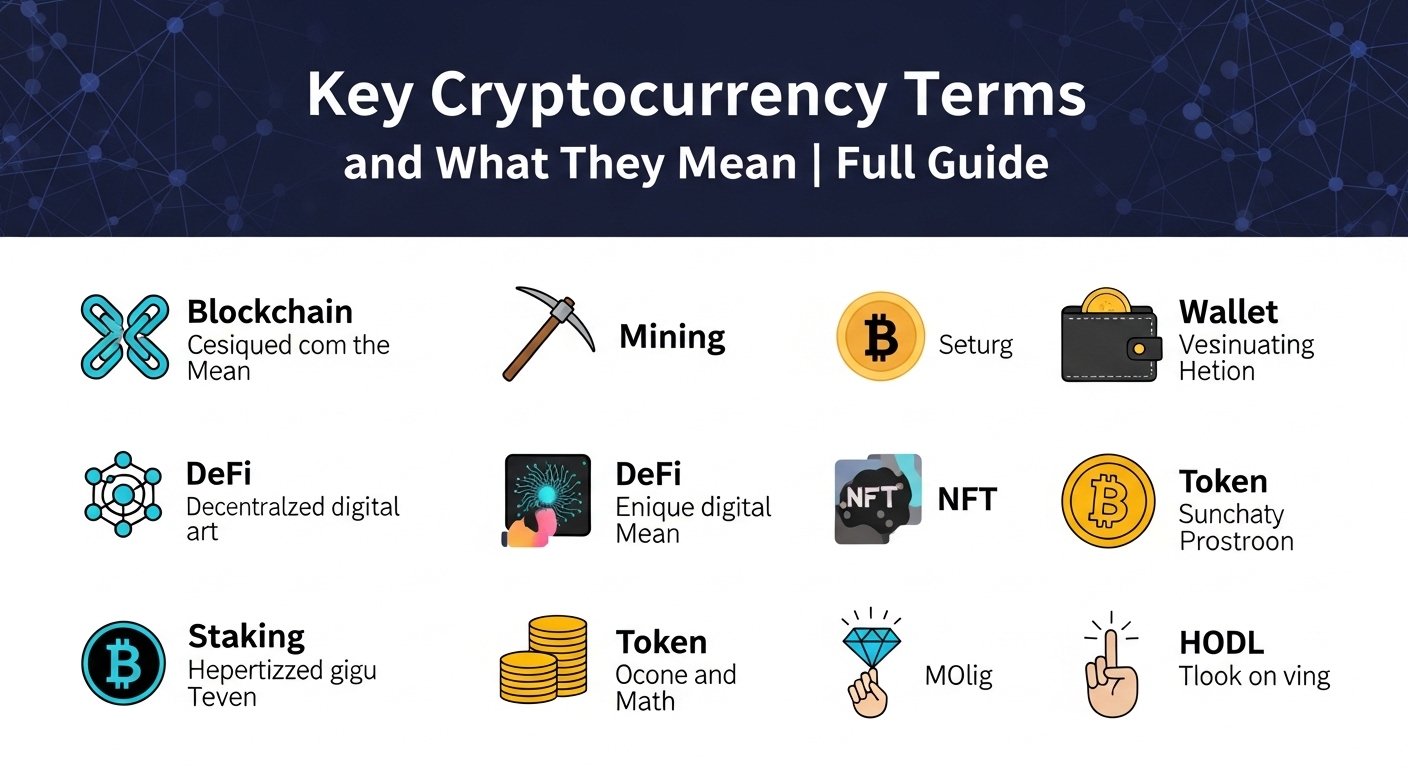
The world of digital finance moves fast, and the language around it can feel like a foreign dialect. Whether you just heard someone mention Bitcoin at a dinner party or your colleague keeps talking about DeFi and NFTs, you are not alone in feeling a little lost.
Cryptocurrency has grown from an obscure experiment into a multi-trillion-dollar asset class with its own vocabulary, culture, and infrastructure. From blockchain technology that powers secure, transparent transactions to wallets, mining, and smart contracts, the ecosystem is rich and layered. This guide breaks down the most important concepts in plain English so that beginners and curious investors alike can navigate the crypto landscape with confidence.
Why Understanding Key Cryptocurrency Terms and What They Mean Matters
Before you buy, invest, or even discuss cryptocurrency, you need a working knowledge of the terminology. Misunderstanding the difference between a hot wallet and a cold wallet, for instance, could mean the difference between keeping your funds secure and losing them forever. Cryptocurrency operates in a largely unregulated space, and that makes education your primary line of defense.
Beyond personal security, understanding crypto terminology also helps you evaluate projects critically. When a new altcoin promises 10,000% returns and boasts of a revolutionary consensus mechanism, knowing what those words actually mean lets you separate genuine innovation from hype. The vocabulary is the gateway to informed decision-making in an industry that thrives on complexity.
The Foundation: Bitcoin, Blockchain, and How It All Started
What Is Bitcoin?
Bitcoin (BTC) is the world’s first decentralized digital currency, created in 2009 by the pseudonymous developer Satoshi Nakamoto. It was designed to allow peer-to-peer transactions without the need for a central authority like a bank or government. Bitcoin runs on a distributed ledger — a shared, public record of every transaction ever made — and it introduced the concept of cryptocurrency to the world. With a fixed supply cap of 21 million coins, Bitcoin is often compared to digital gold because of its scarcity-driven value model.
What Is Blockchain?
A blockchain is the underlying technology that makes Bitcoin — and thousands of other cryptocurrencies — possible. Think of it as a chain of digital blocks, where each block contains a set of verified transaction records. Once a block is added to the chain, it cannot be altered without changing every subsequent block, making the system highly tamper-resistant.
What makes blockchain powerful is its decentralization. Instead of one central server storing the data, thousands of computers around the world (called nodes) hold identical copies of the chain simultaneously. This means no single party controls the ledger, and any attempt to manipulate it would require simultaneously overtaking the majority of all those nodes — an extraordinarily difficult and costly task.
Essential Crypto Vocabulary Every Beginner Should Know
Altcoins and Tokens
Any cryptocurrency that is not Bitcoin is broadly referred to as an altcoin (short for alternative coin). Ethereum (ETH), Solana (SOL), Litecoin (LTC), and Ripple (XRP) are all examples. Within the altcoin category, tokens are a specific type of digital asset built on top of an existing blockchain rather than having their own. For example, many ERC-20 tokens are built on the Ethereum blockchain and rely on its infrastructure to function.
Wallets: Hot vs. Cold
A cryptocurrency wallet is a tool that allows you to store, send, and receive digital assets. Despite the name, wallets do not actually store your coins — they store your private keys, which are the cryptographic passwords that prove you own your funds on the blockchain.
A hot wallet is connected to the internet, making it convenient for frequent transactions but more vulnerable to hacks. Examples include mobile apps and browser extensions like MetaMask. A cold wallet, by contrast, stores your keys offline — typically on a physical hardware device like a Ledger or Trezor. Cold wallets are considered far more secure for long-term storage of large amounts.
Public and Private Keys
Every cryptocurrency wallet generates a pair of cryptographic keys. Your public key is like your bank account number — you can share it freely so others can send you funds. Your private key is like your PIN — it must never be shared with anyone. Whoever holds the private key controls the funds. If you lose it or it gets stolen, your assets are gone, typically with no way to recover them.
Mining, Staking, and How New Coins Come Into Existence
Proof of Work and Mining
Cryptocurrency mining is the process by which new Bitcoin transactions are verified and added to the blockchain. Miners use powerful computers to solve complex mathematical puzzles, a process known as Proof of Work (PoW). The first miner to solve the puzzle earns the right to add the next block and is rewarded with a set amount of newly created Bitcoin — this is called the block reward. As more miners join the network, the puzzles become harder, ensuring that blocks are added at a steady rate regardless of total computing power.
Proof of Stake and Staking
An alternative to Proof of Work is Proof of Stake (PoS), the system used by Ethereum since its 2022 transition known as The Merge. Instead of using energy-intensive computing, validators are chosen to confirm transactions based on the amount of cryptocurrency they stake — essentially lock up as collateral. Staking lets holders earn passive income in the form of rewards, making it an attractive alternative to simply holding assets in a wallet. Proof of Stake is also significantly more energy-efficient than Proof of Work, addressing one of the most common criticisms of cryptocurrency.
DeFi, Smart Contracts, and NFTs: The New Frontier of Cryptocurrency
Smart Contracts
A smart contract is a self-executing program stored on a blockchain that automatically enforces the terms of an agreement when predefined conditions are met. Imagine a vending machine: you insert money, select your item, and the machine delivers it — no cashier needed. Smart contracts work the same way but for far more complex financial agreements, from loans and insurance policies to voting systems and supply chain management. Ethereum was the first blockchain to enable smart contracts at scale, and this functionality is what differentiates it most from Bitcoin.
Decentralized Finance (DeFi)
Decentralized Finance, or DeFi, refers to a suite of financial applications built on blockchain networks that aim to replicate and improve upon traditional financial services — without banks or intermediaries. Using smart contracts, DeFi platforms enable users to lend, borrow, earn interest, and trade assets directly with one another. Protocols like Uniswap, Aave, and Compound are some of the most well-known DeFi applications. The total value locked (TVL) in DeFi protocols has at times exceeded $100 billion, reflecting significant adoption despite the sector’s volatility.
Non-Fungible Tokens (NFTs)
A Non-Fungible Token (NFT) is a unique digital asset verified using blockchain technology. Unlike Bitcoin or Ethereum, which are fungible (meaning each unit is interchangeable with another), NFTs are one-of-a-kind. They can represent ownership of digital art, music, collectibles, gaming items, or even real-world assets. The NFT boom of 2021 brought mainstream attention to the concept, though the market has since matured and critics continue to debate questions of utility and value.
More Key Cryptocurrency Terms You’ll Encounter in the Wild
Exchanges: CEX vs. DEX
A centralized exchange (CEX) is a platform operated by a company that acts as an intermediary for crypto trades. Familiar names include Coinbase, Binance, and Kraken. They are user-friendly and offer features like customer support and fiat on-ramps, but they require you to hand over custody of your assets.
A decentralized exchange (DEX) like Uniswap or SushiSwap allows users to trade directly from their own wallets using smart contracts. There is no company in the middle, no account signup, and no KYC (Know Your Customer) requirements — but the interface can be more complex and the user bears full responsibility for their funds.
Gas Fees
On the Ethereum network, gas fees are the charges you pay to compensate validators for the computing energy required to process and validate transactions. Gas is denominated in Gwei (a tiny fraction of Ether). Fees fluctuate based on network congestion — during peak usage periods, gas fees can spike dramatically, making small transactions economically unviable.
Stablecoins
A stablecoin is a cryptocurrency designed to maintain a stable value, typically by being pegged to a fiat currency like the US dollar. USDT (Tether), USDC, and DAI are popular examples. Stablecoins bridge the gap between the volatility of crypto markets and the stability needed for everyday commerce, payroll, and trading. They are also the primary medium of exchange within DeFi protocols.
HODL, FUD, and FOMO
No guide to crypto terminology would be complete without a nod to the community’s colorful slang. HODL (a misspelling of ‘hold’ that became a battle cry) means to hold your assets through market downturns rather than selling in a panic. FUD stands for Fear, Uncertainty, and Doubt — negative sentiment that can drive prices down. FOMO, or Fear of Missing Out, describes the urge to buy an asset that is rapidly rising in price, often leading to purchases at the top of a market cycle. Recognizing these emotional dynamics is as important as understanding the technology.
Halving
The Bitcoin halving is a programmed event that occurs approximately every four years, cutting the block reward for miners in half. This mechanism controls the rate at which new Bitcoin enters circulation and is a core driver of Bitcoin’s deflationary monetary policy. Historically, halvings have preceded significant bull markets, though past performance is never a guarantee of future results.
Crypto Market Dynamics: Volatility, Liquidity, and Market Cap
When people discuss cryptocurrency investing, several analytical terms come up repeatedly. Market capitalization (market cap) is the total value of all coins in circulation, calculated by multiplying the price per coin by the circulating supply.
This is partly due to the relatively small market size compared to traditional equities, partly due to speculative behavior, and partly due to macroeconomic sensitivity. High liquidity means more stable pricing and easier execution of large trades. Related Cryptocurrency Keywords People Search For
Cryptocurrency glossary for beginners — a full A-to-Z breakdown of crypto language. How does blockchain technology work — deep dives into consensus mechanisms, distributed ledgers, and cryptographic hashing. What is Ethereum and how is it different from Bitcoin — a comparison of the two largest cryptocurrencies by market cap. How to buy cryptocurrency safely — guides on choosing exchanges, protecting wallets, and avoiding scams. What are altcoins, and which ones are worth investing in — analysis of the broader crypto market beyond Bitcoin. DeFi explained for beginners — introductions to decentralized lending, borrowing, and yield farming. What is a crypto wallet and how does it work — tutorials on setting up and securing your first wallet. Bitcoin halving explained — analysis of historical halvings and their market impact. NFT meaning and how NFTs work — explainers on the technology and economics of non-fungible tokens. Crypto staking vs. mining — comparisons of the two primary methods of earning crypto rewards.
Conclusion
The world of cryptocurrency can seem intimidating at first, but it becomes far more approachable once you invest time in understanding the language. The key cryptocurrency terms and what they mean — from the mechanics of blockchain and the purpose of Bitcoin to the intricacies of DeFi, smart contracts, and stablecoins — form a coherent picture of a financial revolution that is still very much in progress. Knowing these terms does not just make you sound informed; it actively helps you protect your funds, evaluate opportunities, and avoid costly mistakes.
Ready to take your understanding further? The crypto landscape rewards the curious — and now, you have the vocabulary to explore it with your eyes wide open.
See more: Bybit and Circle Partner to Expand Global USDC Adoption
