

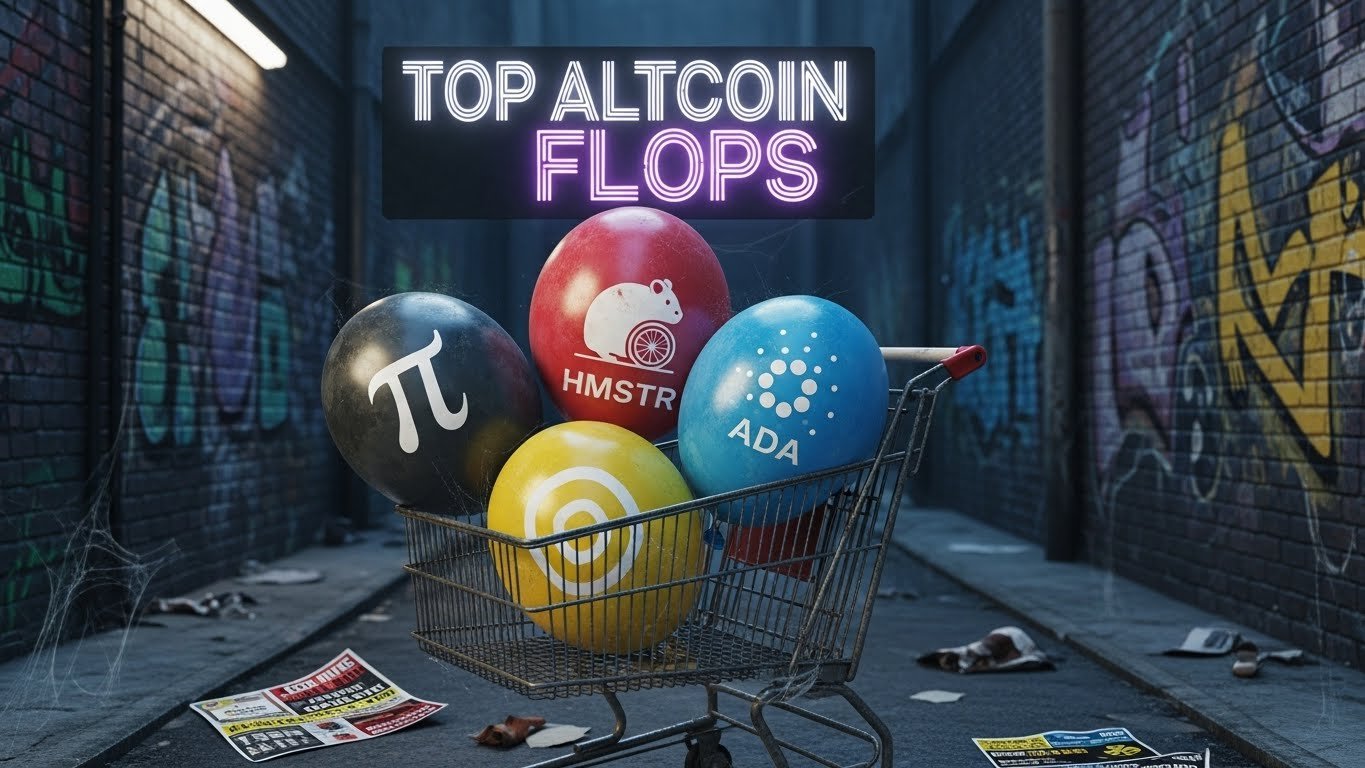
Top altcoin flops in crypto becomes essential for investors seeking to avoid costly mistakes and identify red flags before committing their hard-earned money. In this comprehensive analysis, we examine some of the most disappointing cryptocurrency projects that failed to deliver on their ambitious promises, including Pi Network, HMSTR, Cardano, and several others that have left investors questioning their decisions.
The landscape of cryptocurrency failures serves as a cautionary tale for both newcomers and experienced traders. While mainstream media often highlights success stories of overnight millionaires, the reality reveals that numerous altcoins have crashed spectacularly, taking investor funds with them. By examining these failed crypto projects, we can extract valuable lessons about due diligence, market analysis, and the importance of understanding blockchain fundamentals before making investment decisions.
Why Altcoins Fail
The cryptocurrency ecosystem operates differently from traditional financial markets, creating unique vulnerabilities that lead to project failures. When examining the top altcoin flops in crypto, several recurring patterns emerge that help explain why these digital assets underperform or completely collapse. Market dynamics, technological limitations, regulatory pressures, and team mismanagement all contribute to the downfall of promising projects.
Many altcoin failures stem from unrealistic roadmaps that promise revolutionary technology without the infrastructure or expertise to deliver. Development teams often overestimate their capabilities while underestimating the complexity of blockchain development, smart contract security, and scalability challenges. Additionally, the speculative nature of crypto markets means that hype and marketing can temporarily inflate valuations far beyond any reasonable assessment of actual utility or adoption.
The role of community expectations cannot be understated when analyzing cryptocurrency market failures. Projects that generate massive hype through social media campaigns and influencer endorsements often attract investors based on speculation rather than fundamental value. When these projects inevitably fail to meet unrealistic expectations, the price crashes follow swiftly. Understanding these dynamics helps investors recognize warning signs before becoming victims of the next major crypto disappointment.
Pi Network: The Endless Mining Without Value
The fundamental problem with Pi Network centers on its prolonged development phase and lack of actual blockchain functionality. Unlike established cryptocurrencies that operate on transparent, verifiable blockchains, Pi Network spent years in a closed testing phase where users accumulated tokens that had no real value, couldn’t be traded on exchanges, and existed only within the app’s ecosystem. This raised serious questions about whether Pi Network constituted a legitimate cryptocurrency project or simply an elaborate data collection scheme.
Critics of Pi Network point to several red flags that classify it among failed altcoin projects. The mainnet launch, promised repeatedly and delayed numerous times, finally occurred but with severe limitations on token transferability and exchange listings. The massive token supply created during the mining phase, combined with uncertain tokenomics and distribution mechanisms, suggests that when Pi tokens finally become freely tradable, the market will likely experience massive sell pressure from users looking to liquidate years of accumulated holdings.
The Pi Network phenomenon demonstrates how marketing and ease of access can create the illusion of value without underlying fundamentals. Many participants downloaded the app and clicked the mining button daily for years, investing time and building expectations without understanding basic cryptocurrency principles like supply and demand, market capitalization, or the importance of exchange liquidity. As cryptocurrency investment mistakes go, expecting Pi Network to deliver substantial returns ranks among the most widespread delusions in crypto history.
HMSTR: The Hamster Kombat Disaster
HMSTR, the native token of Hamster Kombat, emerged as one of the most spectacular altcoin flops in recent memory. The project gained massive popularity through its tap-to-earn game mechanics on Telegram, attracting millions of users who spent countless hours tapping their screens to earn virtual currency. The game’s viral growth created enormous hype around the upcoming token launch, with participants expecting substantial rewards for their time investment.
When HMSTR finally launched on exchanges, the reality proved devastating for hopeful participants. The token’s initial valuation disappointed millions of users who had spent months engaging with the platform, as their accumulated earnings translated to mere dollars or even cents worth of tokens. The cryptocurrency bubble burst swiftly as early recipients rushed to sell their tokens, creating immediate downward price pressure that the project never recovered from.
The Hamster Kombat case highlights several critical failures common among failed crypto tokens. First, the project distributed tokens too broadly without creating sufficient demand or utility to support the supply. Second, the gamification mechanics attracted users primarily interested in extracting value rather than contributing to a sustainable ecosystem. Third, the lack of clear utility beyond the game itself meant HMSTR had no compelling use case once the initial excitement faded.
Market analysis of HMSTR reveals the dangers of confusing user engagement with genuine community building. While millions downloaded the game and tapped diligently, these users were incentivized participants rather than committed community members or believers in the project’s long-term vision. When the financial rewards proved negligible, user engagement plummeted, and the token price followed. This pattern repeats frequently among worst performing altcoins that rely on airdrop campaigns and gamification without building real utility or value propositions.
Cardano: Overpromised and Underdelivered
Cardano occupies a unique position among top altcoin flops in crypto because it remains a functioning blockchain with significant market capitalization, yet consistently disappoints investors relative to its lofty promises and peer-reviewed academic approach. Founded by Ethereum co-founder Charles Hoskinson, Cardano marketed itself as a third-generation blockchain that would solve scalability, interoperability, and sustainability challenges through rigorous scientific methodology and formal verification processes.
The fundamental criticism of Cardano centers on its extremely slow development pace and the massive gap between promises and delivered functionality. While the project emphasizes academic rigor and methodical development, years have passed with minimal real-world adoption, limited decentralized applications, and underwhelming smart contract functionality compared to competitors like Ethereum, Solana, and BNB Chain. The Cardano price performance has suffered accordingly, with the token losing significant value from its all-time highs and failing to keep pace with major competitors.
Investors who believed in Cardano’s vision of becoming a dominant smart contract platform have watched other blockchains capture market share while Cardano remains perpetually “under development.” The project’s emphasis on peer-reviewed research and formal methods, while intellectually appealing, has resulted in practical stagnation. Major upgrades arrive years behind schedule, and when they finally deploy, they often lack the transformative impact that justified the extensive development time.
The Cardano situation demonstrates how even well-funded projects with legitimate technology can underperform when execution fails to match ambition. The cryptocurrency market values speed, innovation, and developer adoption, qualities where Cardano has consistently lagged behind competitors. While not a complete failure like some entries on this list, Cardano represents the disappointment of unrealized potential and serves as a reminder that academic credentials and methodical approaches don’t guarantee market success in the fast-moving crypto industry.
Other Notable Altcoin Failures
Beyond the high-profile cases already discussed, the cryptocurrency graveyard contains thousands of failed cryptocurrency projects that promised innovation but delivered losses. BitConnect stands as perhaps the most infamous example, operating an obvious Ponzi scheme that convinced thousands of investors to lock up their Bitcoin in exchange for guaranteed returns through a proprietary trading bot that never actually existed. When the platform collapsed in 2018, investors lost over two billion dollars, and the project became synonymous with crypto scams.
Terra Luna represents another catastrophic entry among worst altcoins to invest in, having collapsed spectacularly in May 2022 and wiping out approximately forty billion dollars in market value within days. The algorithmic stablecoin UST, which was supposed to maintain a one dollar peg through economic incentives and the LUNA token, entered a death spiral when market conditions tested its stability mechanism. The collapse destroyed countless investor portfolios and demonstrated the dangers of algorithmic stablecoins without adequate collateralization.
OneCoin deserves mention not as a legitimate cryptocurrency but as one of history’s largest financial frauds that masqueraded as a crypto project. Marketed aggressively through multi-level marketing schemes, OneCoin never actually created a functional blockchain despite claiming to be a cryptocurrency. The scheme defrauded investors of billions before authorities shut it down and arrested key figures, though founder Ruja Ignatova remains at large on the FBI’s most wanted list.
Safemoon emerged during the 2021 bull market with tokenomics designed to reward holders and penalize sellers through transaction taxes. Initially experiencing parabolic growth, Safemoon quickly revealed itself as a poorly designed token with questionable utility and a development team that made increasingly bizarre decisions. The token has since lost over ninety-five percent of its value from peak, and multiple team members have departed amid controversy and allegations of mismanagement.
Red Flags to Avoid Future Crypto Disasters
Learning from top altcoin flops in crypto requires understanding the warning signs that often precede project failures. Anonymous or pseudonymous development teams should immediately raise concerns, as accountability matters when entrusting funds to a project. While Bitcoin’s Satoshi Nakamoto remains anonymous, that anonymity worked in a different era before thousands of scams had destroyed trust in the space. Modern projects need transparent teams with verifiable credentials and track records.
Unrealistic promises represent another critical red flag when evaluating cryptocurrency investments. Projects claiming to revolutionize entire industries, solve all blockchain limitations, or guarantee specific returns should trigger immediate skepticism. Legitimate blockchain development involves tradeoffs, limitations, and uncertainty. Any project that presents itself as having solved every problem without acknowledging challenges likely lacks either honesty or technical understanding.
The quality and transparency of project documentation provides valuable insights into legitimacy. Whitepapers should contain detailed technical explanations, realistic roadmaps, clear tokenomics, and honest discussions of risks and limitations. Vague marketing materials that emphasize hype over substance, use excessive buzzwords without explanations, or make grand claims without technical backing often indicate failed crypto projects in the making.
Community dynamics offer another important evaluation criterion. Healthy crypto communities engage in substantive discussions about technology, use cases, and development progress. Concerning communities focus exclusively on price speculation, attack critics as spreading fear or uncertainty, and exhibit cult-like devotion to founders or the project. The presence of paid promotion, bot accounts, and fake social media engagement should raise immediate red flags about project legitimacy and long-term viability.
The Psychology Behind Crypto Investment Mistakes
Understanding why investors repeatedly fall for cryptocurrency market failures requires examining the psychological factors that cloud judgment. Fear of missing out plays an enormous role, as seeing others profit from crypto investments creates pressure to participate regardless of understanding or due diligence. This emotional response overrides rational analysis and makes investors vulnerable to hype-driven projects with little fundamental value.
Confirmation bias significantly contributes to cryptocurrency investment mistakes by causing investors to seek information that supports their existing beliefs while dismissing contrary evidence. Once someone invests in a project, they become psychologically committed to its success and interpret ambiguous information favorably. This bias makes it difficult to recognize warning signs or admit mistakes, often leading investors to hold failing positions far too long while adding to losing investments.
The sunk cost fallacy compounds problems for holders of declining altcoins. After investing significant money or time into a project, investors feel compelled to continue supporting it to justify their previous commitment, even when rational analysis suggests cutting losses. This psychological trap keeps investors locked into failed altcoin projects long after evidence clearly indicates the investment thesis has failed.
Social proof and authority bias make investors susceptible to endorsements from influencers, celebrities, or perceived experts. When popular figures promote crypto projects, followers often invest based on trust in the promoter rather than independent research. This dynamic has repeatedly enabled cryptocurrency failures, as unscrupulous projects leverage celebrity endorsements and influencer marketing to attract victims who assume famous individuals have performed adequate due diligence.
Regulatory Challenges Facing Failed Altcoins
The regulatory environment surrounding cryptocurrencies has evolved significantly, with authorities worldwide increasingly scrutinizing projects for securities law violations, consumer protection issues, and fraud. Many top altcoin flops in crypto have faced legal action after collapsing, with founders and promoters held accountable for misrepresentations, unregistered securities offerings, or outright scams. This regulatory pressure has increased as losses mounted and victims demanded justice.
Securities regulators, particularly the United States Securities and Exchange Commission, have taken aggressive enforcement actions against cryptocurrency projects that conducted unregistered token offerings. The question of whether specific tokens constitute securities has profound implications for projects, as securities classification triggers extensive registration requirements, disclosure obligations, and trading restrictions. Many failed crypto projects never anticipated or prepared for regulatory scrutiny, leaving them vulnerable when authorities investigated.
Consumer protection laws have also come into play as authorities investigate misleading marketing, false promises, and failure to deliver on stated objectives. Projects that marketed themselves as revolutionary technologies while delivering nothing of value face potential fraud charges and civil liability. Victims of cryptocurrency failures increasingly turn to legal remedies, filing class action lawsuits and criminal complaints against projects that destroyed their investments.
The evolving regulatory landscape means future altcoin projects face higher barriers to launch and greater accountability for their claims. While increased regulation may reduce innovation and create compliance costs, it also protects investors from obvious scams and forces projects to maintain higher standards. Understanding regulatory requirements becomes essential for distinguishing legitimate projects from future additions to the list of worst performing altcoins.
Learning From Failure to Invest Smarter
The extensive catalog of top altcoin flops in crypto provides valuable education for investors willing to learn from others’ mistakes. Successful crypto investing requires combining enthusiasm for innovation with rigorous skepticism and disciplined risk management. Understanding blockchain technology fundamentals, evaluating team credentials, analyzing tokenomics, and assessing real-world utility all contribute to making informed decisions rather than gambling on hype.
Diversification remains crucial when investing in speculative assets like altcoins. Concentrating investments in single projects exposes investors to catastrophic losses when those projects fail. Spreading risk across multiple assets, including established cryptocurrencies like Bitcoin and Ethereum alongside carefully selected altcoins, provides protection against individual project failures while maintaining exposure to potential winners.
Position sizing discipline prevents individual cryptocurrency investment mistakes from destroying entire portfolios. Investing only what you can afford to lose, limiting altcoin exposure to a reasonable percentage of overall portfolio, and avoiding leverage or borrowed funds for crypto investments all represent essential risk management practices. The emotional appeal of potential massive returns must be balanced against realistic assessment of substantial downside risks.
Continuous learning and adaptation separate successful crypto investors from those repeatedly caught in failing projects. The crypto landscape evolves rapidly, with new technologies, business models, and risk factors constantly emerging. Staying informed through reputable sources, learning from past failures, and maintaining healthy skepticism toward new projects helps investors navigate this challenging market more successfully.
The Future of Altcoin Investments
Despite the numerous failed cryptocurrency projects littering crypto’s history, innovation continues with legitimate projects building real utility and solving genuine problems. The key distinction separates speculative tokens with no fundamental value from cryptocurrencies with actual use cases, adoption, and sustainable economic models. Future altcoin success will increasingly depend on demonstrated utility rather than marketing hype and promises.
Institutional adoption and regulatory clarity will likely reshape the altcoin landscape, rewarding projects that prioritize compliance, transparency, and professional operation. The days of anonymous teams launching projects with vague whitepapers and grandiose promises may be ending as the market matures and participants demand higher standards. This evolution could reduce the frequency of spectacular cryptocurrency market failures while also limiting some of the extreme volatility that characterized earlier crypto cycles.
Technological advancement in areas like layer-two scaling solutions, interoperability protocols, and privacy-preserving technologies creates opportunities for legitimate altcoin innovation. Projects that solve real technical problems, integrate with existing financial infrastructure, or enable new use cases have potential for long-term success. However, distinguishing genuine innovation from marketing buzzwords requires technical understanding and careful analysis.
The maturation of the cryptocurrency market means future investors must balance optimism about blockchain potential with realistic assessment of individual project viability. While the next generation of altcoins may include transformative projects that reshape finance, technology, or governance, the list of top altcoin flops in crypto will undoubtedly continue growing with new cautionary tales. Success in this environment requires combining enthusiasm for innovation with disciplined skepticism and commitment to thorough research.
Conclusion
The comprehensive examination of top altcoin flops in crypto reveals patterns that repeat across failed projects, from Pi Network’s endless promises to HMSTR’s disappointing token launch and Cardano’s chronic underdelivery. Understanding these failures empowers investors to recognize red flags before committing funds to the next overhyped project destined for disappointment. The cryptocurrency market rewards those who combine technological understanding with financial discipline and healthy skepticism.
Moving forward, success in altcoin investing requires rejecting the fear-of-missing-out mentality that drives so many cryptocurrency investment mistakes. Taking time for thorough research, demanding transparency from project teams, analyzing tokenomics critically, and maintaining realistic expectations all contribute to avoiding the next generation of crypto disasters. The lessons from past failures remain relevant regardless of how much the market evolves or how sophisticated new projects appear.
As you navigate the complex world of cryptocurrency investments, remember that protecting your capital matters more than chasing every potential moonshot. The top altcoin flops in crypto demonstrate that even projects with massive hype, millions of users, or academic credentials can fail spectacularly. By learning from these failures and maintaining disciplined investment practices, you position yourself to avoid becoming another cautionary tale in crypto’s ongoing evolution.
Ready to make smarter cryptocurrency investment decisions? Start by researching the fundamental technology behind any project claiming to revolutionize blockchain, verify team credentials independently, and never invest more than you can afford to lose in speculative altcoins. The next major crypto success story exists somewhere in the market, but so does the next addition to the growing list of failed cryptocurrency projects that destroyed investor wealth.
See more;Altcoin Dominance Rebounds: 5 Tokens Set for 2026 Altseason
